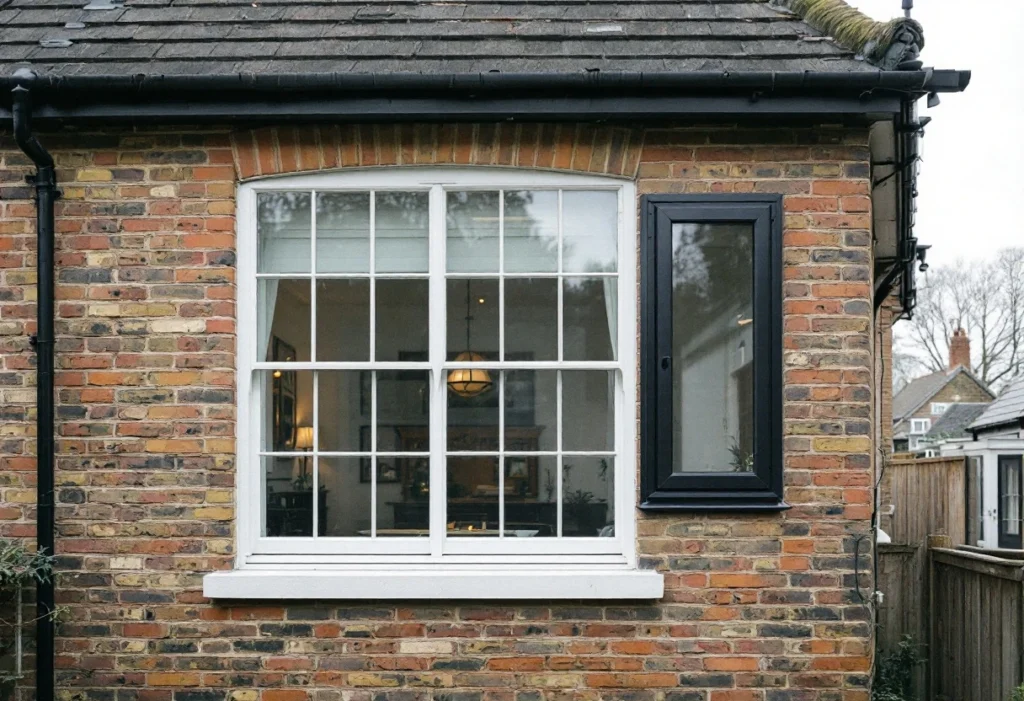
The frame sets how the house looks from the street, how much upkeep the windows need and whether a damaged window can be mended. In a conservation area or a listed building, it can also decide whether you need consent.
This guide compares the three on looks, upkeep, repair, lifespan, security, recycling, cost and heritage rules, starting with a table. Where its sources give no figure for a material, it says so.
How do uPVC, aluminium and timber compare?
How uPVC, aluminium and timber frames compare
| Point | uPVC | Aluminium | Timber |
|---|---|---|---|
| Appearance | Looks different to traditional windows; the material's limited strength rules out the slim sections and glazing bars of most timber and steel windows[7] | Used for windows since the inter-war years[7]; frame widths vary by system, so compare section drawings | The material of many historic windows[5] |
| Thermal minimum | 1.4 W/m²K or band B, whole window[1] | 1.4 W/m²K or band B, whole window[1] | The same limit, since 15 June 2023[1] |
| Upkeep | Clean every six months, adjust yearly, renew seals at least every ten years[7] | Ask the maker for the finish's care instructions | Repaint on a 5 to 8 year cycle[7] |
| Repair | A major problem; complete replacement is often the only option[7] | Not covered by the sources used here | Most traditional windows can be repaired, even in very poor condition[5] |
| Lifespan | Less than 25 years, according to Historic England[5] | No figure in the sources used here | Many well-maintained traditional windows survive over 100 years[5] |
| Security | Not necessarily more secure than traditional windows[7] | Not necessarily more secure than traditional windows[7] | Can be made secure with locks and anti-lift devices[7] |
| Recycling | Possible, but still not done widely[5] | Not covered by the sources used here | Not covered by the sources used here |
| Older and listed buildings | Historic England regards it as unsuitable for older buildings[5] | In a listed building, recent windows may be replaced in an appropriate material and pattern[6] | Repair of significant historic windows comes first[5] |
Scroll sideways to see all columns
The thermal row is the same in every column, so the real choice lies in the other rows.
Which thermal standard should every replacement window meet?
An external window is a controlled fitting under the Building Regulations, so the rules on heat loss, safety glazing, ventilation and escape apply to every frame. A registered installer certifies the work through a competent person scheme, or a building control body approves it[3].
Approved Document L sets the heat-loss limit for new windows in an existing home: a U-value of no more than 1.4 W/m²K, or a Window Energy Rating of band B or better[1]. The U-value measures heat lost through the glass and frame[3], so lower is better. It covers the whole window, so ask for that figure, not the glass alone. The new window should also be no worse than the old one[1].
A temporary allowance let timber windows reach 1.6 W/m²K or band C until 14 June 2023. The full standard has applied to timber since 15 June 2023[1]. A 2026 edition of Approved Document L takes effect on 24 March 2027. It keeps the same limit for windows in existing homes[2].
Listed buildings, homes in conservation areas and scheduled monuments need not comply in full where that would unacceptably alter their character or appearance, but should comply as far as is reasonably practicable. Where a window cannot meet the limit for that reason, it should reach a centre pane U-value of no more than 1.2 W/m²K, or single glazing should gain low-emissivity secondary glazing. Building control should consider the advice of the council's conservation officer[1].
What are uPVC windows like to live with?
The design, detailing and operation of uPVC windows make them look different to traditional ones. Historic England notes that makers have not been able to copy the slim sections and glazing bars of most timber and steel windows, because of the limited strength of the material[7]. Its current guidance calls uPVC unsuitable for older buildings because of how it looks and opens[5].
The frames still need regular care. Historic England advises cleaning them every six months to prevent discolouration. They should be lubricated and adjusted every year, and the weather seals and gaskets renewed at least every ten years[7]. Repairs can be a major problem. Because of the nature of the material, complete replacement is often the only option[7].
Historic England puts the service life of uPVC windows at less than 25 years. It compares that with well-maintained traditional windows, many of which survive for over 100 years[5][6]. uPVC can be recycled, but this is still not done widely. Historic England therefore judges its carbon cost higher than that of an upgraded traditional window[5].
What are aluminium windows like?
Bronze and aluminium began to be used for windows between the wars. By the 1950s, aluminium had become cheap enough to use as a window material. On some houses from those decades, metal windows are part of the original design[7].
Many of those older metal windows are steel. After the First World War, steel windows were strong, slim and cheap, which made them highly competitive with timber sashes[7]. Historic England advises that traditional metal windows can often be repaired and made more energy-efficient rather than replaced[7].
A new aluminium window should meet the same whole-window limit as the other materials[1]. Frame and sash widths vary from one system to another. Ask for the section drawings and compare them with the existing windows. The sources behind this guide give no lifespan, upkeep or recycling figures for aluminium, so ask the maker for the finish's care instructions and expected life in writing.
What are timber windows like?
Timber is the material of many historic windows[5]. Most traditional ones were made from the heartwood of slow-grown Scots pine. Properly maintained, many historic parts are still in use after 150, 200 or even 250 years[7].
Some of that durability came from the wood: many historic windows were made from old-growth timber that is no longer available[5]. Plantation-grown trees contain more sapwood, which is more permeable than heartwood and a food source for fungi[7]. For new timber windows, ask which timber is used and how it is treated.
Timber needs painting. Historic England's maintenance schedule includes preparing and redecorating painted surfaces on a 5 to 8 year cycle[7]. In return, timber can be repaired. Rotten sills and sections can be pieced in with matching timber, and even windows in very poor condition can be returned to good working order[5].
Is one frame material more secure than another?
Historic England notes that modern materials and designs are not necessarily more secure than traditional windows[7]. Traditional windows can be fitted with window locks, dual screws, anti-lift devices, mortice bolts and sash chains. They can still be opened for ventilation and cleaning[7]. Whatever the frame, ask what locks, hinges and glass are specified, above all for ground-floor windows and any reached from a flat roof.
What changes in a conservation area or a listed building?
For most houses, new windows of similar appearance to those used in building the house need no planning permission[4]. Three things can change that. An Article 4 direction can withdraw permitted development rights. A listed building needs listed building consent for any significant works, inside or out. A conservation area may carry additional restrictions[4]. How to check each one is set out in conservation-area rules for windows.
Historic England states that replacing windows in a listed building will always need listed building consent, and adding double or triple glazing to historic windows usually will too. It strongly encourages owners to keep significant historic windows and not to replace them without good reason[5]. In a conservation area, it suggests reading the appraisal to see what character the area protects, and checking for Article 4 directions[5].
Its advice note on listed buildings goes further. Recent windows that add nothing to a building's special interest can generally be replaced with double-glazed windows of an appropriate material, glazing bar pattern and detailing. Original windows, and others that contribute to that interest, should not be replaced, though their panes could take slim-profile or vacuum double glazing. Stuck-on or applied glazing bars rarely replicate the character of historic windows and are unlikely to be acceptable[6].
Where the original windows should stay, Historic England describes two ways to improve them:
Slim-profile double glazing. Where the old glass has not survived, it may be possible to fit thin double-glazed units without harm. The thicker glass can mean renewing the frame[5].
Secondary glazing. A separate inner window fitted inside the existing one. It can reduce heat loss as effectively as double glazing, especially with low-emissivity glass, and is better at reducing noise. Reversible secondary glazing does not generally need listed building consent[5]. Ready-made systems normally use painted aluminium frames slim enough to sit within a sash window's staff bead, so shutters and sills can stay[8].
How does the frame material affect the cost?
Each material is made and finished differently, so one opening priced in all three gives three figures. This guide does not rank them, because the rest of the specification also moves the price:
- Size and number of windows, and the style: casement, sash, tilt and turn or bay.
- Glass: double or triple, low-emissivity coatings, acoustic or safety glass.
- Colour and finish, inside and out.
- Access to upper floors, and making good at the reveals inside and out.
- The heritage route, where a planning or listed building consent application is needed.
Running costs differ too. Timber is repainted every 5 to 8 years, uPVC seals are renewed, and a uPVC window that cannot be repaired is replaced whole[7].
To compare quotes fairly, keep the material, style, glass and Window Energy Rating the same, so the difference you see is the price.
Which material suits which house?
A listed building. Start from repair. Replacement always needs listed building consent. Historic England favours keeping significant windows, and reversible secondary glazing does not generally need consent[5].
A period house in a conservation area. Check for an Article 4 direction and read the appraisal first[5]. Without a direction, windows of similar appearance usually need no planning permission[4]. With one, you may need to apply for planning permission[4].
A house with original metal windows. Find out whether they are steel or aluminium. Traditional metal windows can often be repaired[7]. If they are replaced, compare frame widths with the originals before choosing a material.
A house with modern windows and no designation. Any of the three can work. Weigh upkeep, repair and expected life against how long you plan to stay. Ask for the whole-window U-value or Window Energy Rating with each quote[1].
Next steps
Window replacement can be booked with E&N Build Group as a standalone job. The site visit and the written quotation are free, and neither commits you to anything. To get a quote for replacement windows, send the enquiry with the postcode, the type of work, a short description and whether drawings exist. Mention any conservation area, Article 4 direction or listing you have found. Coverage is London, Surrey and surrounding counties, confirmed for each project from the postcode. Before work starts you get a written scope with the quotation. It states what is included, what is not, and what is provisional. At handover you receive the certificates and sign-offs that apply to the work done.