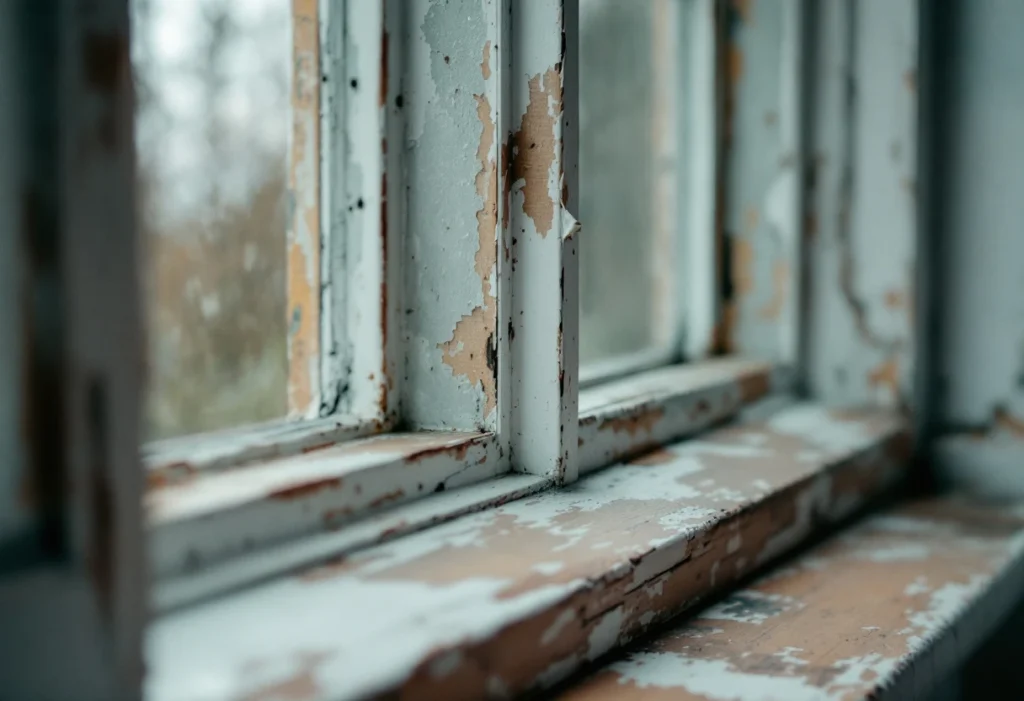
Most window problems show up as one of a few signs: misting you cannot wipe away, wet glass on cold mornings, draughts, soft timber, or a sash that will not open or close. Some point to one worn part. Others point to a frame at the end of its life.
This guide covers what each sign means, what a repair involves and when replacement is the better answer. It stops at the decision: how a replacement is surveyed and fitted is covered separately. Look at each window from inside and from the ground, and leave upper-floor frames to whoever surveys them.
Which signs point to repair, and which to replacement?
The table pairs each common sign with what it usually points to and the kind of work involved. The last column shows when replacement enters the decision.
Common window problems and where they lead
| Sign | What it usually points to | Repair route | When replacement comes into it |
|---|---|---|---|
| Misting between the panes | The sealed unit: the space between the panes is meant to be sealed, and the seals of double glazing erode over time[4] | A new sealed unit in the existing frame[10] | When the frame is failing as well |
| Condensation on the room side | Damp room air meeting a cold surface[5] | Ventilation; check timber paint on the inside for early decay[2] | When you want to upgrade single glazing and the frames need replacing anyway |
| Draughts | Air gaps around the opening parts, where most heat lost through windows escapes[3] | Draught-proofing[3] | When the frame is too distorted or decayed to close properly |
| Rot in timber | Water absorbed after paint breaks down, often at cills and joints[2] | Joinery repair, doing the minimum needed[1] | When decay runs through most of the frame |
| Sticking or dropped sash | Over-painting, tight beads or seized pulleys on sliding sashes[2]; hinges or fixings on casements | Freeing, adjusting or overhauling the sash[1] | When the frame is distorted beyond adjustment |
| Failed hinges, handles or locks | A fault in one component | Replacing or adjusting the part | When parts cannot be found and the frame is also worn |
| Single glazing and heat loss | Heat lost through gaps and glass[3] | Draught-proofing and secondary glazing[1] | When the frames are due for replacement in any case |
| Noise | Sound through gaps and glass | Draught-proofing[2]; secondary glazing[4] | When replacement is already justified on other grounds |
Scroll sideways to see all columns
How to recognise each problem
Misting between the panes
Wipe the glass on both sides. If the misting or droplets stay, they are inside the unit. A double-glazed unit is two layers of glass with a sealed space between them, and its seals erode over time, a weakness secondary glazing does not share[4]. Moisture inside the unit means the seal is no longer keeping damp air out. The fault is in the unit, not necessarily the frame, so check the frame before deciding.
Condensation on the room side
Condensation forms when warm, damp air passes over a cold surface and cools below its dew point[5]. On the inside face of a window, it shows that the room air is damp and the glass is cold. It is not, on its own, a fault in the window. Approved Document F describes purge ventilation, at a high rate, as a way to disperse water vapour from a room quickly[8]. On timber windows, check the paint on the inside: interior paint failure caused by condensation is one of the signs of possible wet rot[2].
Draughts and heat loss
About one-fifth of a home's heating is lost through windows, and most of that escapes through air gaps rather than through the glass[3]. A draughty window is often a gap problem first. Draught-proofing a sash window in good condition can reduce air infiltration by as much as 86 per cent[3]. For single glazing, the main alternative to replacement is secondary glazing, which can reduce heat loss by over 60 per cent[1].
Rot in timber frames
The signs to look for are paint failing inside or outside, frame joints opening and the wood surface breaking down[2]. Cills are a common weak point. Water gets in after the paint breaks down, and can creep into the joint between the timber cill and the masonry sub-cill[2]. Traditional windows can often be repaired simply and economically, usually at a cost well below replacement[2]. Decay in one cill is a different job from decay through most of the frame.
Sticking sashes, dropped casements and failed hardware
A sliding sash that will not move, or moves badly, may be over-painted, held by stop beads fitted too tightly, or running on seized pulley wheels[2]. Each of those can be put right, and sash parts can usually be removed for repair without damage[1]. A casement that has dropped and catches the frame, a failed hinge or a lock that no longer engages is a fault in one component. Ask whether the part can be adjusted or replaced before assuming the whole window must go.
Noise
Draught-proofing helps to reduce noise and rattling as well as draughts[2]. Historic England notes that secondary glazing is even better than double glazing at reducing noise[4].
What a repair involves
A repair keeps the frame and fixes the part that has failed. For traditional windows, Historic England advises an experienced joiner, the right materials and the minimum work needed. It notes that repairs usually cost less, will not usually need consent, and are more sustainable than replacement[1]. The usual kinds of repair are these:
A new sealed unit. Where only the glass has misted, the unit can be replaced in the existing frame. FENSA lists repairs where the frame is not included among the work its replacement-window scheme does not cover[10].
Joinery repairs. Decayed parts of a timber cill, sash or frame are repaired by a joiner, doing the minimum needed to fix the problem[1].
Secondary glazing. An extra window fitted inside the existing one. It has no seals that erode, and with good timber and continued maintenance it should last as long as the original single-glazed window[4].
uPVC windows are the main exception. Historic England notes that they are not maintenance-free and can be difficult to repair[1].
When replacement is the better answer
Replacement makes sense when the frame itself has failed: widespread decay, a frame too distorted to close, or a uPVC frame that cannot be repaired. Age is a guide as well. Historic England puts the life of double-glazed windows at roughly 30 years, against 60 to 100 years for single-glazed windows[1].
Once you replace, Building Regulations apply. They have applied to all replacement glazing since 1 April 2002, covering thermal performance, safety, air supply, means of escape and ventilation[9]. In a home, that means:
Thermal performance. A replacement window should have a U-value of no more than 1.4 W/m²K, or a Window Energy Rating of band B or better, and be no worse than the window it replaces[6]. New editions of Approved Documents L and F take effect on 24 March 2027[11]; the new Approved Document L keeps the same figure for windows[7].
Ventilation. If the old windows had trickle vents, the new ones should too, no smaller and controllable. If they had none, the work must not leave ventilation worse than before[8].
Means of escape. The new opening should give at least the same potential for escape as the window it replaces[9].
Proof of compliance. A registered installer issues a certificate when the work is complete. Otherwise a building control body checks the work and issues a certificate of compliance[9].
Listed houses and conservation areas need checking first. If the house is listed, or in a conservation area with an Article 4 direction, you are likely to need consent to alter the windows[1]. Work to a listed house, or any house in a conservation area, need not comply fully with the energy standards where that would unacceptably alter its character or appearance[6]. Where a window cannot meet the U-value for that reason, a centre-pane U-value of 1.2 W/m²K, or single glazing with low-emissivity secondary glazing, is the alternative[6].
If replacement is the answer, the next decision is the frame. The guide to choosing replacement window materials compares uPVC, aluminium and timber. Window replacement can be booked with us as a standalone job, and the window replacement page explains what the work includes.
Which route suits which window?
Older timber windows in fair condition. Repair and draught-proofing, with secondary glazing if heat loss or noise matters. Historic England encourages owners to keep significant historic windows and not to replace them without good justification[4].
Local decay or a sticking sash. Joinery repair and an overhaul, then keep the paint in good order. Properly maintained, historic timber windows can last indefinitely[1].
uPVC frames failing on several fronts. Replacement is usually the practical route, because uPVC can be difficult to repair[1].
- Listed houses and conservation areas. Check consent with the council before deciding either way.