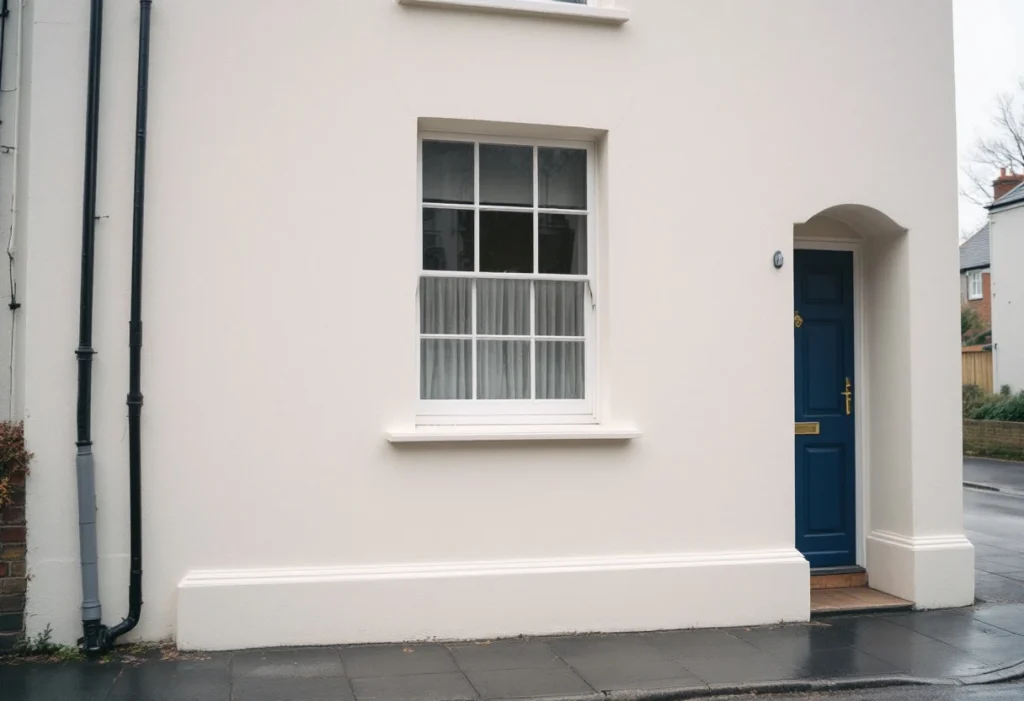
Render does two jobs. It keeps rain out of the wall, and it sets how the house looks from the street. The common systems do both in different ways. On an older solid wall, the wrong one can trap moisture in the wall it is meant to protect[3].
This guide compares sand and cement render, one-coat monocouche, thin-coat silicone and acrylic finishes, and lime render. It looks at cracking, colour, breathability, upkeep, the wall underneath and relative cost, starting with a table. It describes each system in plain terms. Where its sources give no answer for a product, it says so, and the chosen system's own technical instructions govern.
How do the four render systems compare?
Render systems compared (cost relative only)
| Criterion | Sand and cement | Monocouche (one-coat) | Thin-coat silicone or acrylic | Lime |
|---|---|---|---|---|
| What it is | Sand and cement, mixed on site or bought premixed, built up in coats by hand | A factory-made render, usually cement-based, with the colour mixed in, applied in one coat | A thin finish bound with silicone or acrylic resin, laid over the system's own base coat | Lime-based mixes, traditionally applied as a two- or three-part coating[1] |
| Colour and finish | Smooth, textured or dashed; usually painted, so the paint carries the colour | Coloured right through; scraped or textured; no paint | Coloured right through, in a fine texture; no paint | Needs a permeable finish: impermeable coatings can make an older wall decay faster[1] |
| Cracking | Can crack like any render, and cracks let damp into the wall behind[1] | Check the maker's requirements for the background, mesh, beads and movement joints | Depends on the whole system, including the base coat and mesh: check the data sheet | Can crack like any render[1]; repair in matching materials[2] |
| Breathability | Cement-based: Historic England gives an example of cement render trapping moisture in an older wall[3] | Check the stated permeability, and whether the maker approves it for older solid walls | Check the stated permeability, and whether the maker approves it for older solid walls | Lime renders help limit liquid water getting into the wall[3]; traditional materials take up moisture and release it slowly[2] |
| Upkeep | The paint needs renewing from time to time | No paint to renew; ask for the maker's cleaning advice | No paint to renew; ask for the maker's cleaning advice | Keep finishes permeable[1]; repair like for like[2] |
| Usual backgrounds | Blockwork, and modern brick or render where a painted finish is wanted | The backgrounds its data sheet lists | The backgrounds its system data sheet lists, over its own base coat | Older walls of traditional construction: solid brick, stone or earth[2] |
| What you pay for | Site-mixed materials, several coats, then paint; repainting is a later cost | A coloured factory product in one coat, with no paint | A base coat, usually with mesh, then a finish, all from one system | Several coats built up in turn[1] |
Scroll sideways to see all columns
The breathability row matters most on an older house. On a modern wall, the other rows mostly decide the look and the upkeep.
What is sand and cement render?
It is mixed on site from sand, cement and water, sometimes with lime or additives, and built up by hand in coats. The first coat is scratched to give the next one a key. The finish can be smooth, textured or thrown with stones. Historic England describes pebbledash, also called roughcast, as a form of stucco that includes gravel[1].
Most sand and cement render is painted, and the paint carries the colour. That makes a colour change easy later, but the paint has to be renewed to keep the walls looking fresh. Like any external render, it can crack, and cracks let damp into the wall behind[1]. Ask how the coats, the beads at corners and openings, and the details at sills and ground level will be done.
It suits blockwork and modern brick where a painted finish is wanted. On an older solid wall, it is the kind of cement-based render that Historic England shows trapping moisture and increasing decay[3].
What is monocouche render?
The name is French for one coat. It is a factory-made render, usually cement-based, with the colour mixed through it. It goes on as a single coat, sometimes in two passes, and is then scraped or textured. Because the colour runs right through, there is no paint layer to renew.
Three points need checking against the product chosen:
- The backgrounds it is approved for, and any mesh, beads or movement joints the maker requires.
- The colour. It is fixed at the start, so look at a sample panel in daylight, not a printed chart. Ask how a later repair would be matched.
- Older walls. On a solid wall of traditional construction, ask whether the maker approves the product for that kind of masonry at all.
What are thin-coat silicone and acrylic finishes?
Each is the top layer of a system, not a render on its own. A base coat goes on first, usually with a reinforcing mesh bedded into it. The thin, through-coloured finish goes over that. The difference between silicone and acrylic finishes is the binder: a silicone resin in one, an acrylic resin in the other.
Because each layer comes from the same system, its data sheet governs. It says which backgrounds the system covers, which base coat and mesh it needs, the weather it can be applied in, and how it is cleaned and repaired. Ask for it with the quote. Makers' claims about water repellence, flexibility and dirt pick-up vary, and this guide has not verified them. Compare them on the data sheets, not the brochures.
When is lime render the right choice?
Lime is the traditional render for older buildings. Historic England notes that early renders were usually lime-based mixes, applied in two or three coats[1]. Buildings of traditional construction were made with natural materials that manage moisture by taking it up and releasing it slowly[2]. Most historic buildings have solid walls that are vapour permeable[4]. Lime works with that: lime and earth-based renders help limit the liquid water getting into the wall[3].
Modern materials can work against it. Historic England warns that repairing a traditionally built house with modern materials can trap moisture and reduce permeability[2]. It shows a cement-based render that trapped moisture in a wall and increased decay[3]. It also warns that impervious fillings or impermeable coatings can make a wall decay faster[1]. Any paint or coating over lime should stay permeable for the same reason.
Where there is clear evidence that a building was meant to be rendered and the render has been lost, Historic England says reinstating it in compatible materials protects the walls from damp and improves thermal performance[4].
What does the wall underneath change?
Three kinds of wall come up most often on houses:
Solid brick in older houses. Some traditionally built houses have solid walls of brick, stone or earth[2]. Historic England advises matching repairs to the original materials in physical properties as well as looks, so they age the same way[2]. That points to lime, or to a modern system whose maker confirms in writing that it suits solid, permeable masonry.
Blockwork. The Planning Portal notes that blockwork normally needs rendering outside, with a thickness that depends on the block. Brickwork generally resists the weather well on its own[9]. On a blockwork extension, the finish usually follows the rest of the house.
- Existing render. Old render can carry a new system only if it is sound and well bonded, and listed as a background in the new system's instructions. Cracked or hollow areas come off and the wall behind is repaired. Where an older solid wall has cement render, taking it off may be part of the job.
The order matters: the background is checked first, and the system that suits it is chosen second. A finish chosen before anyone has looked at the wall may have to change.
How does the render system change the cost?
This guide does not rank the four systems on price, because the rest of the job moves it too. What you pay for differs by system. Sand and cement means site-mixed materials, several coats and then paint, with repainting as a later cost. Monocouche is a coloured factory product in one coat. A thin-coat system is a base coat, usually with mesh, and a finish from one maker. Lime is built up in several coats[1]. Whatever the system, these drive the total:
- The area and the number of elevations.
- Access and scaffolding.
- Preparation: stripping old render and repairing the wall behind.
- Details at corners, sills, windows, doors and ground level.
- Weather, which sets when render can go on.
- Approvals: a planning application, or an insulation upgrade under the Building Regulations, where either applies.
To compare quotes fairly, ask each one to name the same system, the same preparation and the same finish.
Does rendering need planning permission or Building Regulations approval?
Planning first. Outside the protected areas below, render needs no planning application if the materials are of similar appearance to those on the outside of the house[7]. That means a similar look, not the same material, and colour and style both count[8]. On article 2(3) land, cladding any part of the outside of a house with render is not permitted development. That covers conservation areas, National Parks, Areas of Outstanding Natural Beauty, the Broads and World Heritage Sites[8]. A listed building needs listed building consent for any significant works[7]. Rendering bare brick changes the look, so ask the council before you choose.
Then the Building Regulations. Re-rendering can count as renovating the wall. When more than half of a wall's surface is renovated, regulation 23 of the Building Regulations requires the whole wall to be brought up to the insulation standard in Approved Document L, as far as is technically, functionally and economically feasible[3][10]. If that standard is not technically or functionally feasible, or would not pay back within 15 years, the wall is upgraded as far as it can be within those limits[5]. On historic and traditional houses, energy efficiency should be improved only if it will not cause long-term damage to the fabric[5]. A 2026 edition of Approved Document L takes effect on 24 March 2027 for most work, with the same test and the same values for walls[6]. Ask building control whether the upgrade applies before you choose a system, because it changes the specification.
Which render suits which house?
A period house with solid brick walls. Lime, or a modern system its maker confirms for solid, permeable masonry. Avoid cement-based render, which can trap moisture in that kind of wall[3].
- A later house with sound cement render. Re-render or overcoat with a system that lists the existing render as a background. Choose a through-coloured finish if you would rather not repaint.
A blockwork extension. It normally needs render[9]. Match the colour and texture to the house, so the work stays of similar appearance[8].
A house in a conservation area or another protected area. Planning permission comes first for any render cladding[8]. A listed house needs listed building consent for significant works[7].
- An owner who wants colour without painting. Monocouche or a thin-coat finish. See a sample panel on site before you decide.
Next steps
Exterior rendering can be booked with E&N Build Group as a standalone job. The site visit and the written quotation are free, and neither commits you to anything. To get a rendering quote, send the enquiry with the postcode, the type of work, a short description and whether drawings exist. Mention the age of the house and any conservation area or listing you know of. Coverage is London, Surrey and surrounding counties, confirmed for each project from the postcode. Before work starts you get a written scope with the quotation. It states what is included, what is not, and what is provisional until the old render comes off.