Wiring ages out of sight, inside walls and under floors. Faulty and ageing wiring is a major cause of electrical fires in the home[3].
This guide sets out the reasons to book an assessment. It does not show you how to find or fix a fault. Testing and repairs are work for an electrician, and the electrician's findings decide what, if anything, needs doing.
What does an electrical assessment check?
The assessment is a periodic inspection, and the report it produces is an Electrical Installation Condition Report, or EICR. It is an inspection with testing, to check whether the installation is in a satisfactory condition for continued service. The electrician looks for damage, deterioration, defects and dangerous conditions, and for anything that does not comply with the present-day safety standard[1]. Electrical Safety First advises using a registered electrician for the inspection and test[1].
The report either declares the installation safe for continued use or highlights suggested or urgent repairs[7]. Each item found is given a code[1]:
- C1. Danger present, risk of injury. Immediate remedial action required.
- C2. Potentially dangerous. Urgent remedial action required.
- C3. Improvement recommended. Much as with a car's MOT, it is a recommendation, not a requirement.
- Further investigation. A separate code for items that need further investigation.
These codes, not a list of symptoms, decide whether repairs, upgrades or a rewire are needed.
How often should the wiring be checked?
Electrical Safety First gives these intervals for a periodic inspection[1].
Intervals for a periodic inspection, as Electrical Safety First states them
| Property | Interval | Notes |
|---|---|---|
| Owner-occupied home | At least every 10 years[1] | Its home buyers' page recommends checks on a ten yearly basis for owner-occupiers[2] |
| Tenanted property | Every 5 years, or at each change of occupancy, whichever is sooner[1] | A legal requirement for private landlords across the UK[7] |
| Business | At least every 5 years[1] | Commercial premises |
| Moving into a new property | Have the wiring checked[3] | From its home safety guide |
Scroll sideways to see all columns
For private landlords the check is a legal duty, at intervals not exceeding five years[7]. If you own your home and have no record of a past inspection, that alone is a reason to book one.
Which events are a good time for an assessment?
Buying a home
Electrical Safety First's advice to buyers is to check whether a recent EICR has been done, and to have a full EICR carried out by a registered electrician[2]. A seller does not have to provide one[1]. Its other checks for buyers are visual: look at sockets and light fittings for wear and tear, and see whether the consumer unit (fusebox) has RCDs[2].
Before major building work
Where building work will extend or alter the electrics, Approved Document P says only the new work must meet current standards. The existing installation should still be checked to make sure that[8]:
- existing equipment, both yours and the electricity distributor's, is suitable for the extra loads from the new work;
- adequate protective measures are used;
- the earthing and equipotential bonding arrangements are satisfactory.
Upgrading the existing installation is only required if the new work would make it less safe, or its state means the new work cannot be operated safely[8]. An inspection before the work is planned shows early whether either applies, so any upgrade is planned rather than found halfway through.
When you add appliances or rely on extension leads
Overloading sockets creates a risk of fire[4]. Plugging too many appliances into a socket-outlet or extension lead can be dangerous, especially high-powered ones[6]. Electrical Safety First advises against plugging one extension lead into another. If you regularly rely on extension leads, cable reels and adaptors, it suggests having more wall sockets installed[5].
Which warning signs mean an electrician should look?
Electrical Safety First says never to ignore warning signs like burning smells, buzzing or crackling, fuses blowing or circuit breakers tripping[3]. Its guidance lists these:
Burn or scorch marks around a socket or plug, or other visible damage to plugs or socket-outlets[2][5].
A smell of hot plastic or burning near an appliance or socket[5].
Buzzing or crackling from light switches, light fittings or socket-outlets[2][4].
An RCD that keeps tripping, which is likely to mean a fault that needs investigating[1].
Heat: socket-outlets that feel hot[6], or light fittings with curled labels, discolouration or scorch marks[2].
On a plug, lead or appliance, the advice is to unplug it and contact the retailer or manufacturer[5]. If socket-outlets have burn marks or feel hot, get a competent registered electrician to check them[6]. Do not open sockets, switches or the consumer unit to look for the cause yourself.
A sign shows that something needs looking at, not what is wrong. A tripping RCD may point to one appliance or to the wiring itself[1], and only testing tells them apart.
Which features suggest an older installation?
Electrical Safety First's home safety guide lists these[3]:
- cables coated in black rubber, lead or fabric;
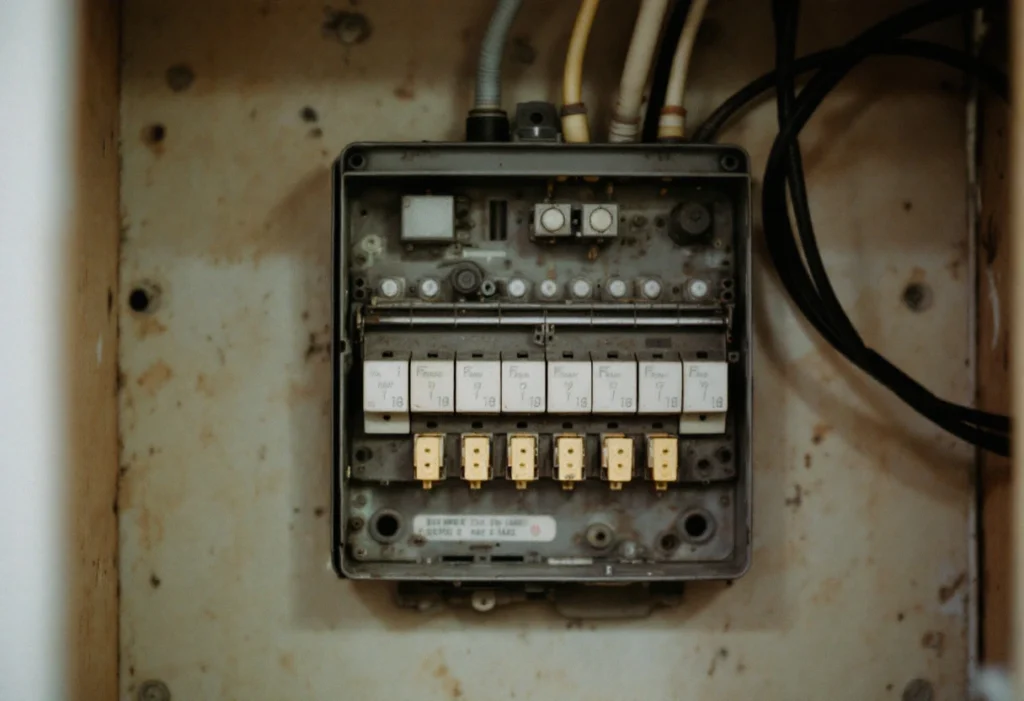
- a fusebox with a wooden back, cast iron switches or a haphazard mixture of fuseboxes;
- older round pin sockets and round light switches, braided flex hanging from ceiling roses, and brown and black switches;
- sockets mounted in skirting boards, and wall-mounted light switches in bathrooms.
The guide says these may suggest the installation is over 40 years old and may need rewiring, and advises asking a registered electrician for an EICR[3]. The wording is may, not must. Its advice for home buyers adds that electrics more than 50 years old should be checked and updated[2].
Rewirable fuses and missing RCDs
Older homes often have rewirable fuses, which disconnect the circuit when a fault or overload current goes above a safe level. Newer homes are likely to have circuit breakers, which switch off if there is a fault. An RCD does a different job: it is a life-saving device designed to prevent a fatal electric shock if you touch something live, such as a bare wire[3].
An RCD has a 'Test' or 'T' button[2]. Electrical Safety First suggests pressing it every three months, and getting a registered electrician's advice if the RCD does not switch off or will not reset[3]. Without an RCD in the consumer unit, it advises plug-in RCDs for all the sockets[2].
Does an old installation mean it needs rewiring?
Not on its own. Electrical Safety First says there are no set guidelines for when a property should be rewired, and old wiring is not necessarily unsafe. For a 1980s house, it says the answer depends on condition rather than age. If the wiring has been tested, is in good condition and works effectively, there is no requirement to rewire[1].
So the lists above are reasons to book an inspection, not a diagnosis. The EICR codes decide what follows, and the outcome could be a single repair, added RCD protection, new circuits or a full rewire.
Some of that work is notifiable under the Building Regulations in England: a new consumer unit, a complete new circuit, and alterations to circuits in the spaces around baths and showers. It is either carried out by an installer registered with a competent person scheme, who self-certifies it, or notified to a building control body or registered third-party certifier before work starts[9].
What to do next
If any of the reasons above apply, book an EICR with a registered electrician and keep the report. If it recommends a rewire, read what a rewire involves and costs before you decide.
If the report leads to electrical work, it can be booked with us as a standalone job. Before work starts, the written scope states what is included, what is not, and what is provisional until the work opens up. At handover you receive the certificates that apply to the work done.