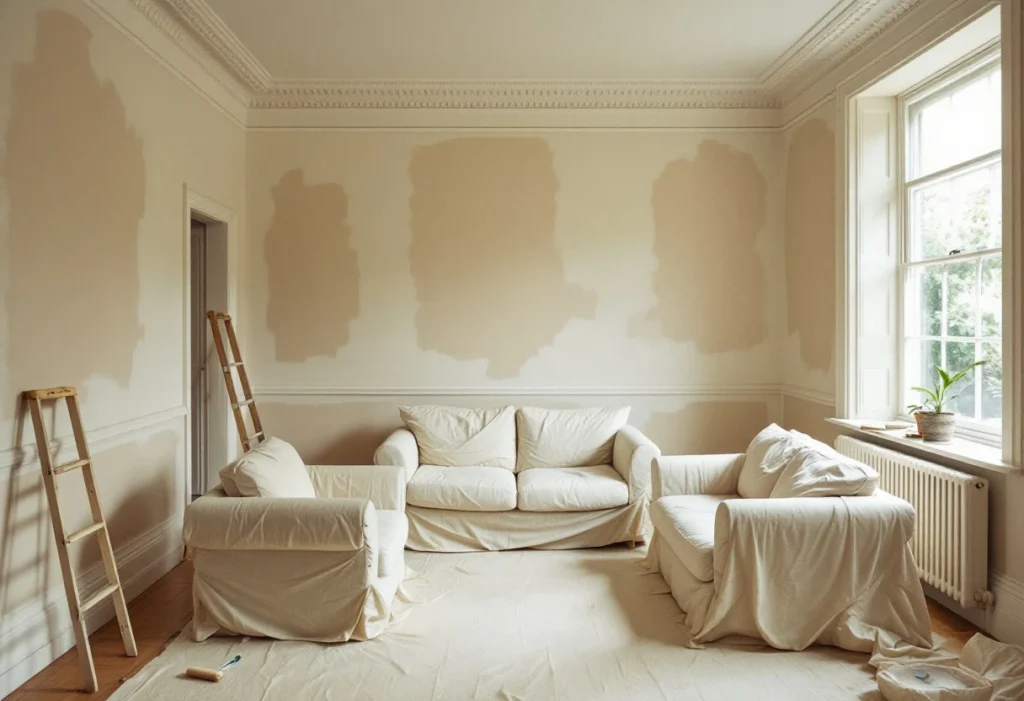
Two quotes to paint the same room can be far apart because they describe different jobs. One assumes sound walls, a similar colour and a single top coat. The other allows for filling cracks, sanding and sealing new plaster, two or three coats for a colour change, and the skirtings, door and window frames. Outside, access adds another layer: a stepladder, a tower or a full scaffold. This guide sets out what a decorating job involves, what changes the price, what a quote should say, and how VAT applies. It gives no price ranges, for the reason below.
Why there is no standard decorating price
Decorating is often priced per room, per day or per square metre. Each figure hides the variable that matters most: how much preparation the surfaces need and how they are reached. A day rate says nothing about how many days a job takes, and a room price assumes a room in average condition. A reliable figure comes from someone who has seen the surfaces and written down what is included.
What does a decorating job involve?
The work follows a fixed order. Skipping a stage usually shows later as cracking, flaking or patchy colour.
- Protection. Furniture moved or covered, floors sheeted, and fittings, sockets and handles masked or removed.
Preparation. Loose and flaking paint removed, cracks and holes filled, surfaces sanded and washed down. Manufacturers' guidance is that surfaces to be painted must be sound, clean, dry and free from defective or poorly adhering material[10].
Sealing and priming. New or bare plaster sealed with a thinned first coat[10], and bare wood or metal primed.
Finish coats. Usually ceilings first, then walls, then woodwork. The number of coats is set by the surface and the colour change[11].
- Making good and clearing up. Fittings refitted, edges checked, and the room handed back clean.
What drives the cost of painting and decorating?
Each driver changes how much time the job takes, or how much is unknown when it is priced.
The condition of the surfaces
Walls with cracks, old patch repairs, flaking paint or nail holes need more preparation than walls that were painted recently and are in good order. Damage left by stripping old wallpaper, by damp or by knocks shows through the finish unless it is made good first. On older paintwork there is another check to make: manufacturers warn that pre-1960s paint on wood and metal may contain lead, and that special precautions are needed when preparing it[10], which adds time.
New plaster
British Gypsum says its plaster must be thoroughly dry before decorating, although a coat of permeable paint can be applied in the meantime[9]. Trade practice is then to seal new or bare plaster with a thinned first coat before the finish coats; one manufacturer's guidance allows up to 1 part clean water to 3 parts paint for its matt emulsion[10]. Ratios differ between products, so follow the one on the tin. Decorating soon after plastering may mean returning for the finish coats once the walls have dried.
The number of coats
The normal finish is two coats. One manufacturer says that on previously painted surfaces in good condition, where a similar colour is used, one coat may be enough, and that a significant colour change may need more[10][11]. Strong colours, and big changes from dark to light, are the usual reasons for the extra coat.
Woodwork, doors and windows
Skirtings, architraves, doors and window frames take far longer per square metre than walls. They need sanding, filling and often a primer or undercoat, and gloss and satin finishes show every flaw in the preparation. Sash windows and panelled doors take longer again.
Ceilings and textured coatings
Ceilings are slower to paint than walls and need more access equipment. A textured ceiling raises a separate question. HSE says asbestos may be present in any building built or refurbished before 2000, and lists textured decorative coatings, commonly referred to as Artex, among the places it can be found[8]. It advises not to repair or remove asbestos materials without training, and that material in good condition is often best left where it is[8]. A textured ceiling that may contain asbestos is painted over, not sanded or scraped, until it has been checked.
Furniture and occupied rooms
An empty room is quicker to decorate than one that has to be emptied, sheeted and put back together, and a house that is lived in during the work may need rooms done one at a time.
How does access change the price?
Height adds equipment, set-up time and safety work. The Work at Height Regulations 2005 apply to employers and to anyone who controls work at height, and require it to be properly planned, supervised and carried out by competent people with the right equipment[1]. The first duty is to avoid work at height where it is reasonably practicable to do the job safely another way[2]. In practice that shapes decorating access:
Ladders and stepladders. They are not banned, and can be a sensible option for low-risk, short-duration tasks, but they should not automatically be the first choice[3]. HSE defines short duration as tasks taking less than 30 minutes[4].
Towers. A mobile tower scaffold suits longer work on stairwells, high ceilings and single elevations. HSE says anyone erecting one should be competent and trained, for example under the PASMA scheme[5].
Scaffolding. Painting the outside of a house, the gable end or the eaves often needs a scaffold, which has to be designed and put up by competent people[22] and inspected before first use and then every 7 days while it is up[5][6].
Scaffolding on the pavement or road needs a licence from the highway authority, usually the council. GOV.UK says it is the builder's or scaffolding company's responsibility to get the licence, and the householder's to check they have it and that it won't run out before the work is finished[6]. The requirement comes from section 169 of the Highways Act 1980[7].
What about painting the outside of the house?
Exterior work adds weather to the price. Manufacturers set minimum temperatures and conditions for their products: one water-based masonry paint is not to be used below 7°C or in rain, fog or relative humidity above 80%[12], and a solvent-based exterior gloss is not to be used below 5°C[13]. Outside work is therefore planned around the forecast, and a wet spell can stretch a job across more days.
Repainting the outside normally needs no planning application. Painting the exterior of a building is permitted development, unless the painting is for advertisement, announcement or direction[14]. A listed building is different: works that would affect its character need listed building consent[15], and an Article 4 direction lets a council withdraw permitted development rights across a defined area[20], which is most common in conservation areas. Check with the council before changing the colour of a listed or conservation-area house.
What changes the time a decorating job takes
| Factor | Less time | More time |
|---|---|---|
| Surfaces | Sound, recently painted | Cracked, flaking, patched or stained |
| Plaster | Previously painted | New or bare plaster that needs drying and sealing[9][10] |
| Colour | Similar to the existing[11] | Significant colour change[10] |
| Woodwork | Walls and ceilings only | Skirtings, doors, frames and sash windows |
| Access | Reachable from the floor or a stepladder | Tower or scaffold, with a highway licence if on the pavement[6] |
| Exterior weather | Dry, mild spell | Cold, damp or changeable weather[12] |
Scroll sideways to see all columns
What should a decorating quote include?
Citizens Advice says to get a quote in writing rather than rely on a verbal one, and lists what it should include[18]:
- A fixed total price, not a daily rate.
- A breakdown of all the work to be done and the materials needed, with separate costs for each part.
- How long the price is valid for, and whether it includes VAT.
- When the price can go up, for example only if you agree to extra work.
For decorating, also check that the quote says which rooms and surfaces are included, what preparation is allowed for, how many coats, who supplies the paint and in which finish, and what access equipment is included. Citizens Advice also suggests being cautious if one price is a lot lower than the others, as it may not be for the same work[18]. Setting several quotes side by side is covered in comparing building quotes.
With an E&N Build Group quotation you get a written scope before work starts, stating what is included and what is not.
How does VAT apply to decorating?
VAT is charged only by VAT-registered businesses. The standard rate is 20%[17], and HMRC says work to an existing building is normally standard-rated[16]. The main exception for homes:
Renovating an empty home. The 5% rate can apply when renovating a dwelling that has not been lived in during the 2 years immediately before the work starts, and HMRC names redecoration among the repair and maintenance work that can be reduced-rated during that renovation[16].
Scaffolding stays standard-rated. Even on a reduced-rate job, HMRC lists the erection and dismantling of scaffolding as standard-rated[16].
Second homes don't qualify. A home lived in occasionally during those 2 years, for example as a second home, cannot be reduced-rated[16].
If you think the 5% rate applies, ask for the rate in writing before you accept a quote.
Who is responsible for safety on a domestic job?
Redecoration counts as construction work under the Construction (Design and Management) Regulations 2015[21], and on a job for a homeowner the client duties pass automatically to the contractor, or to the principal contractor if there is more than one[19]. In practice the decorator plans the access and protects the house and the people in it.
Next steps
The site visit and the written quotation are free, and neither commits you to anything. The enquiry asks for the postcode, the type of work, a short description and whether drawings exist; for decorating, say which rooms or elevations and what the surfaces are like now. For how decorating is scoped and run, on its own or after other work, see our painting and decorating service.