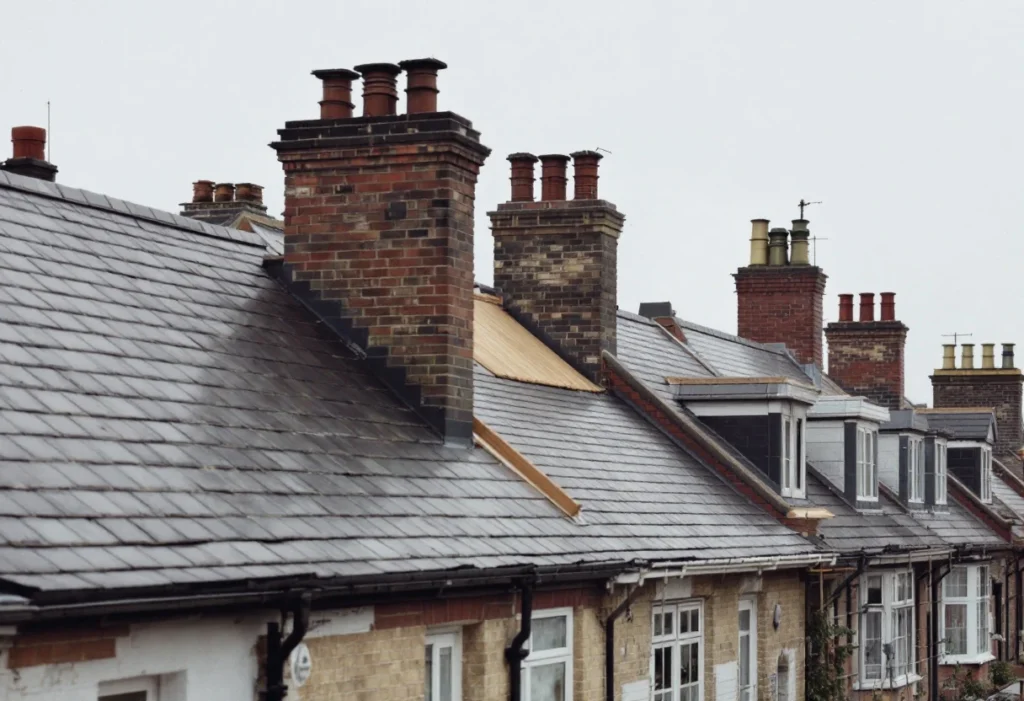
Replacing a roof covering can involve three separate sets of rules: planning law, which is about how the roof looks; the Building Regulations, which are about how it performs; and wildlife law, which protects bats and nesting birds in the roof. They are independent, so a roof that needs no planning permission can still need Building Regulations approval and a bat survey. This guide covers each at roof-specific depth. How they fit with the rest of the approvals system is set out in the approvals framework.
Does re-roofing need planning permission?
Usually not. The Planning Portal says work to the roof of a house, such as re-roofing, that does not materially affect its external appearance will usually not require planning permission[1]. The legal basis is that maintenance or alteration works which do not materially affect the external appearance of a building are not development at all[2]. Replacing like with like falls within that.
Three situations need checking first:
- A different-looking covering. Changing the material, colour or profile can materially affect the appearance, which makes it development that needs either permitted development rights or planning permission.
Article 4 directions. A council can withdraw specified permitted development rights across a defined area with an Article 4 direction[3]. The Planning Portal says they are most common in conservation areas[21], and one London borough gives requiring planning permission to change roof tiles as an example[22].
Listed buildings. Works that would affect the character of a listed building need listed building consent[4], and carrying them out without it is an offence[23]. Historic England says consent is needed to change the roof's shape, height, pitch, internal structure or type of covering, or to add a rooflight[5].
When do the Building Regulations apply?
A roof that separates heated rooms from the outside is a thermal element. Regulation 23 of the Building Regulations 2010 says that where the renovation of a thermal element amounts to more than 50% of its surface area, or is part of a major renovation, the whole element must be brought up to the energy efficiency requirements, in so far as that is technically, functionally and economically feasible[6]. A major renovation is one where more than 25% of the surface area of the whole building envelope is renovated[7]. Work required by regulation 23 counts as building work in law[8].
The Planning Portal's guidance on work to an existing roof puts it this way: you will not normally need a building control application to repair or re-cover a pitched or flat roof if less than 25 per cent of the total building envelope and less than 50 per cent of the roof is affected[9]. It adds that approval is needed if those limits are exceeded, if structural alterations are made, if the fire performance of the new covering is significantly different, or if the new covering increases the weight of the roof covering by 15 per cent or more[9]. Its re-roofing page says that in most situations replacing a roof will need Building Regulations approval, and that the thermal insulation should be improved as part of re-covering[10].
Where the wording differs
The regulations use "more than 50%" and "more than 25%"; the Planning Portal says no application is normally needed below those figures. Close to either threshold, check with building control or a registered roofer before starting.
Heavier or lighter coverings
Changing the covering material can change what the roof structure has to carry. Approved Document A says the structural integrity of the roof and its supports should be checked where the work significantly changes the loading, which it defines as an increase of more than 15%[11]. Going the other way, a much lighter covering can need the roof's anchorage against wind uplift checked[11]. Work that leaves a building no longer complying with the structural or fire requirements, where it previously did, is a material alteration under the regulations[8]. The Planning Portal says a change of material, for example from slate to tiles, is likely to need approval[10].
The insulation upgrade
Approved Document L sets an improved U-value of 0.16 W/m²K for a renovated roof, and allows a lesser standard where the full upgrade is not technically or functionally feasible or would not pay back within 15 years[12]. It also says work to listed buildings and buildings in conservation areas need not fully comply where doing so would unacceptably alter their character or appearance[12]. A revised Approved Document L takes effect on 24 March 2027[20]; its values for renovated roofs are unchanged[24].
Building control or a registered roofer
There are two ways to show the work complies. One is a building control application made before work starts. The other is to use a roofer registered with a competent person scheme for replacing roof coverings on pitched and flat roofs; GOV.UK lists NAPIT and CompetentRoofer as the authorised schemes[13]. A registered installer self-certifies the work and gives you a certificate within 8 weeks of completion[25].
Skipping both has consequences. GOV.UK says the person doing the work could be prosecuted and fined if it doesn't comply, and without approval you won't have the certificates of compliance you may need when you sell[14].
Bats
All bat species, their breeding sites and resting places are fully protected by law, and GOV.UK lists repairing or replacing a roof among the activities that can affect them[15]. Under the Conservation of Habitats and Species Regulations 2017 it is an offence to deliberately capture, injure, kill or disturb a bat, or to damage or destroy a breeding site or resting place[16].
Before work. Where bats may be using the roof, an expert bat survey is needed, and if harm can't be avoided, a mitigation licence from Natural England is required[15].
During work. The Bat Conservation Trust recommends pausing all work immediately if a bat is found and getting advice from the statutory nature conservation body or an ecological consultant[17].
One bat is enough. A roost is defined in law as any place a wild bat uses for shelter or protection, and the number of bats doesn't matter[17].
The National Bat Helpline, run by the Bat Conservation Trust, gives free advice on behalf of Natural England, but GOV.UK notes it cannot advise on building works that need planning permission[15].
Nesting birds
Under the Wildlife and Countryside Act 1981 it is an offence to intentionally take, damage or destroy the nest of any wild bird while it is in use or being built[18]. GOV.UK says that in most cases harm can be avoided by timing work to avoid the breeding season, and that there is no licence to permit development or construction[19]. Eaves, gutters and gaps under tiles are common nest sites, so a roof inspection before work starts should look for active nests.
Re-roofing approvals at a glance
| Situation | Planning | Building Regulations |
|---|---|---|
| Like-for-like covering, ordinary house | Usually not development[1][2] | Approval or a scheme certificate if more than half the roof is renovated[6][13] |
| Different-looking covering | Check: may materially affect appearance | Likely to need approval[10]; structure checked if loading rises by more than 15%[11] |
| Area under an Article 4 direction | Check the direction with the council[3] | As for any house |
| Listed building | Listed building consent for a change of covering[4][5] | Energy upgrade relaxed where it would harm character[12] |
| Small repair | Not development[2] | Normally no application within the Planning Portal's limits[9] |
| Bats or nesting birds present | Independent of planning | Independent: survey, timing and licence rules apply[15][19] |
Scroll sideways to see all columns
Next steps
The site visit and the written quotation are free, and neither commits you to anything. Tell us whether the house is listed or in a conservation area, what the roof is covered in now, and whether you want to change it. For how roof work is scoped and run, see our roofing service.