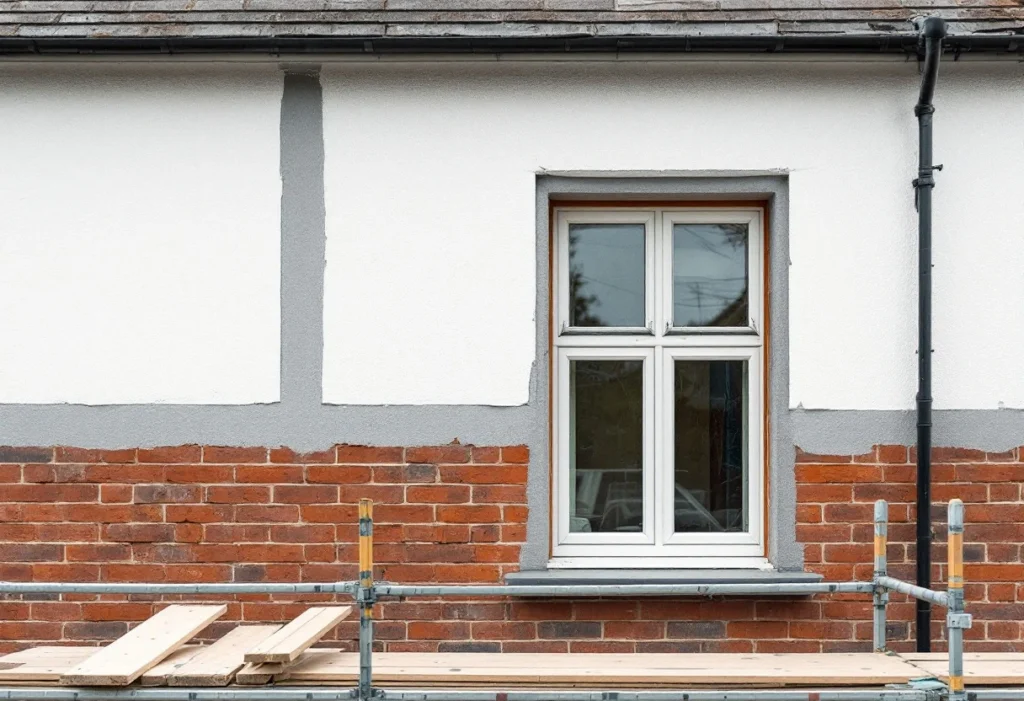
External wall insulation is often priced per square metre of wall, but the flat wall is the simplest part of the job. The cost sits in the edges and interruptions: windows and doors, the eaves and verges, downpipes, meter boxes and flues, and anything that has to be repaired before the wall can be covered. This guide covers what an EWI job involves, what drives the cost, the approvals, VAT and the funding schemes as they stand. It gives no price ranges, for the reason below.
Why there is no standard price
A rate per square metre assumes a plain wall. Two houses with the same wall area can need very different amounts of work if one has bay windows, a porch, a gas meter and several downpipes and the other doesn't. A reliable figure comes from a survey of the walls and a written scope.
What does external wall insulation involve?
Survey and repairs. The walls, roof edges, gutters and downpipes are checked, and repaired where needed before anything is covered[1].
Scaffolding. A scaffold goes up around the walls being insulated, with a licence if it stands on the pavement[4].
Taking things off the wall. Downpipes, meter boxes, lights, satellite dishes and other services are removed or prepared for moving[1][2].
Insulation. Boards are fixed to the wall, or an insulating render or framed system is applied; Historic England describes these as the three main methods[2].
Openings and edges. Window and door openings, and the roof and wall junctions, are adapted to the deeper wall[2].
Finish. For rendered systems, a reinforced base coat and then the render; otherwise the chosen cladding or brick slips[1].
- Putting things back. Pipes, services and fittings are refitted on the new wall surface, and the work is certified or inspected.
What drives the cost of external wall insulation?
Wall area, shape and openings
The more windows, doors, bays and projections a wall has, the more cutting, returning and detailing it needs. Historic England says the increased wall depth often makes other work necessary, such as adapting roof and wall junctions and window and door openings, and repositioning rainwater downpipes and services fixed to the outside[2].
Window reveals and sills
To minimise cold bridges at the reveals, Historic England says windows and doors may need to be relocated further forward in the overall wall thickness, though this is not always feasible[2]. Even where the windows stay, each opening still has to be adapted to the deeper wall, which takes time at every window and door.
Eaves, verges and the roof line
The Energy Saving Trust says EWI will often require works to extend the roof[1], so that the eaves overhang still covers the thicker wall. The National Audit Office identified poorly installed external insulation that lets water in, for example where roof eaves were not effectively extended to fully cover the insulation, as one of the failures on government schemes[3]. Extending eaves and verges is roofing work, priced separately or as part of the EWI quote.
Pipes, meters and flues
Rainwater pipes and utility meter boxes often have to be moved[1]. Any work on gas appliances in a home must be done by a Gas Safe registered engineer, and HSE notes that flues have to be in safe positions at specified distances from the boundary[6], which matters where EWI changes the wall around a boiler flue.
The insulation and the finish
The insulation type and thickness set the U-value the wall reaches and the depth added to it. The finish can be smooth, textured, painted, tiled, panelled, pebble-dashed or brick slips[1], and each costs differently in materials and labour. On traditional buildings, Historic England says compatible, moisture-permeable materials such as lime renders and rain-screen cladding are suitable, and that plastic-based insulations are ordinarily ruled out[2].
Repairs before insulating
The Energy Saving Trust says it is crucial to complete any repair and maintenance to the exterior before adding wall insulation, including damaged brickwork or pointing, roofs and overhangs, and gutters and downpipes[1]. Repairs found during the survey are a separate line in the quote.
Scaffolding
Scaffolding on the highway, including the pavement, needs a licence from the highway authority[5]. GOV.UK says the builder or scaffolding company gets the licence, and the householder should check they have it and that it won't run out before the work is finished[4]. The Energy Saving Trust suggests fitting EWI at the same time as other external work, such as a new roof, new windows or gutter repairs, to make the most of scaffolding that is already up[1].
Neighbours and party walls
Approved Document L's example for external insulation says to assess the impact of the increased wall thickness on adjoining buildings[7]. On a semi or terrace, the junction with the neighbour's wall needs a detail, and insulating one house of a pair changes how the pair looks.
Approvals as cost items
Depending on the house, EWI can need planning permission or listed building consent, and it usually needs either a building control application or a scheme installer's certificate, because insulating more than half of a wall triggers regulation 23[17]. GOV.UK notes that Building Regulations approval is different from planning permission, and you might need both[8]. Each is a line in the budget: application fees, any drawings, and the certificate.
External wall insulation cost drivers
| Driver | What it adds | Source |
|---|---|---|
| Many openings and projections | Cutting, returns and detailing at every window, door and bay | Historic England[2] |
| Window reveals | Adapting each opening, sometimes moving windows forward | Historic England[2] |
| Eaves and verges | Extending the roof edge to cover the insulation | Energy Saving Trust; NAO[1][3] |
| Pipes and meters | Moving downpipes and meter boxes | Energy Saving Trust[1] |
| Gas flues | Gas Safe registered engineer for any gas work | HSE[6] |
| Repairs first | Brickwork, pointing, roof edges, gutters | Energy Saving Trust[1] |
| Scaffold on the pavement | Highway licence | Highways Act 1980[5] |
Scroll sideways to see all columns
What should an EWI quote include?
- Which walls, their area, and the insulation type and thickness, with the U-value it achieves.
- The finish, and how the reveals, sills, eaves, verges and junctions with neighbours are detailed.
- Which pipes, meters and fittings are moved, and who moves them.
- Repairs included, and anything provisional until the walls are opened up.
- Scaffolding and the licence, and how the work will be certified or inspected.
Setting several quotes side by side is covered in comparing building quotes. With an E&N Build Group quotation you get a written scope before work starts, stating what is included, what is not, and what is provisional.
How does VAT apply?
The installation of energy-saving materials in residential accommodation in England, Wales and Scotland is zero-rated from 1 April 2022 to 31 March 2027[9]. HMRC's notice lists insulation for walls among those materials, and says that from 1 April 2027 these installations revert to the reduced rate of 5%[10].
Installation only. The relief applies when the materials are installed; HMRC says the sale of energy-saving materials by a retailer is always standard-rated[10].
Other work at the same time. Where insulation is installed with other goods and services, HMRC says you must decide whether it is one supply at one rate or several supplies at different rates[10]. Repairs, roof work and new windows may be charged differently, so ask for the VAT treatment in writing.
What about grants and funding schemes?
Government schemes have funded solid wall insulation, but they change often. As at the date this guide was checked:
ECO4. Ofgem says ECO4 runs until 31 December 2026[11], and the government's Warm Homes Plan says the Energy Company Obligation is coming to an end[13].
Great British Insulation Scheme. Ofgem says the scheme began in April 2023 and closed on 31 March 2026[12].
Warm Homes: Local Grant. Run by councils in England for eligible households where the council has funding, and may include wall insulation[14]. Its delivery window runs to 31 March 2028, and upgrades must follow PAS 2035 with TrustMark-registered installers[15].
The Warm Homes Plan also says some insulation measures, particularly solid wall insulation, have become less viable in recent years following supply chain cost increases[13], and government guidance acknowledges quality problems with some solid wall insulation fitted through past schemes[16]. Eligibility is decided by each scheme, not by the installer; check GOV.UK or your council for the current position.
Next steps
The site visit and the written quotation are free, and neither commits you to anything. Tell us the house type, which walls, and whether other external work such as roofing or windows is planned. For how the work is scoped and run, see our external wall insulation service.