Waterproofing is what decides whether a basement can be used as a room. BS 8102, the British Standard code of practice for protecting below-ground structures against water, sets out the types of protection, the grades of dryness and how they are combined. The standard itself is sold by BSI, so this guide draws on BSI's own description, the Basement Information Centre's overview of the 2022 changes, LABC Warranty's 2024 technical manual (Version 12) and the Property Care Association's guidance. LABC Warranty's Version 13 manual has applied to new quotes since January 2026, so check its current wording for a warranted project. The guide explains the systems; it doesn't recommend a product.
What is BS 8102?
BS 8102:2022, Protection of below ground structures against water ingress, is the current code of practice, published on 31 March 2022[1]. BSI says it covers waterproofing barrier materials applied to the structure, structurally integral watertight construction, and drained cavity construction[1]. It replaced the 2009 edition; the Basement Information Centre says a key change was the grades of performance, amended to provide greater clarity, and that the three types of protection were kept[2].
Approved Document C points to BS 8102 for walls subject to groundwater pressure, including basement walls, and for floors subject to water pressure, though it still cites the 1990 edition[11]. The Environment Agency's flood risk standing advice names BS 8102:2022 for preventing water from the surrounding ground entering below-ground structures such as basements[12].
The three types of protection
Type A: barrier protection, or tanking
LABC Warranty says Type A barrier protection can be referred to as tanking, and that barrier membranes must be fully bonded[4]. The Property Care Association defines it as protection that depends on a separate barrier system applied to the structure[6], and says it was historically known as tanking[8]. Under the 2022 standard the barrier is either internal or external, with no sandwiched arrangement[3].
Type B: structurally integral protection
With Type B, the structure itself provides the protection[6]: BSI describes this as structurally integral watertight construction[1], typically walls and floors designed and built to resist water passing through them.
Type C: drained protection
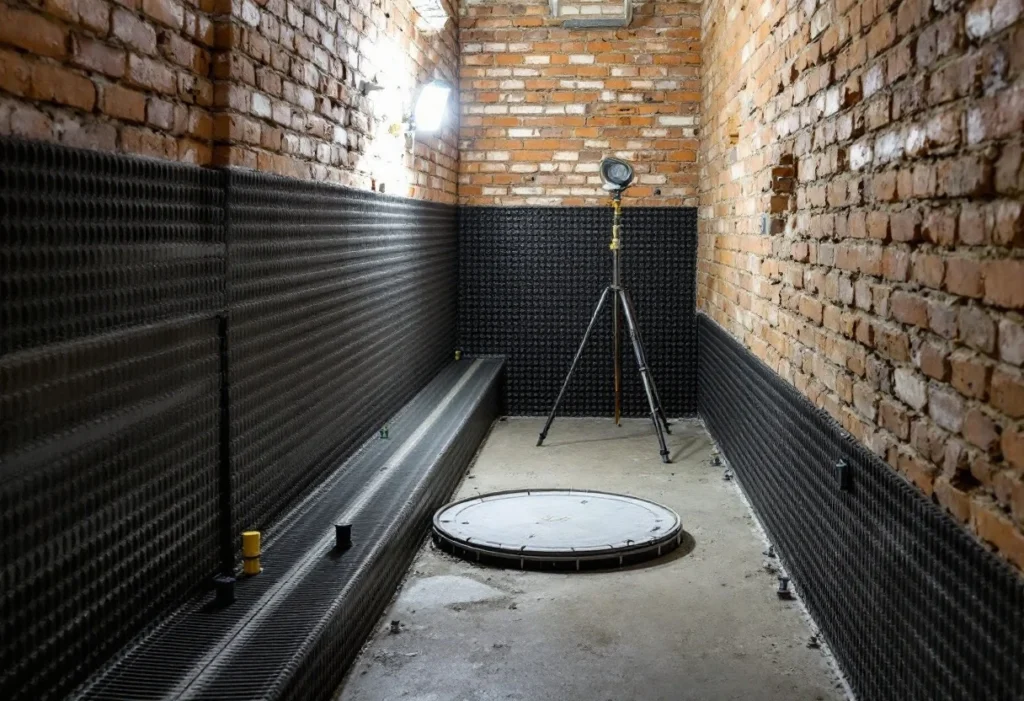
LABC Warranty says Type C drained systems are often referred to as water management systems: they collect and remove any seepage of water through the structure, which differs from Types A and B, which provide barriers[4]. The usual component is a cavity drain membrane, which the Property Care Association describes as a cuspated, also known as dimpled or studded, flexible high-density polymer sheet placed against the internal face of the structure to intercept water and direct it to a drainage system; it notes that a cavity drain membrane is not considered to constitute tanking[6].
The PCA also points out the limits: cavity drainage systems can't withstand hydrostatic pressure, pumps need routine maintenance, the system will fail if the power supply breaks down, and continued success relies on continued maintenance[8].
BS 8102 types of waterproofing protection
| Type | How it works | Often called | What it relies on |
|---|---|---|---|
| Type A | A barrier applied to the structure, inside or outside[3] | Tanking[4] | Full bonding of the barrier[4] |
| Type B | The structure itself resists water[1] | Structurally integral | The design and construction of the structure |
| Type C | Water is let through, collected and removed[4] | Water management; cavity drain[4] | Drainage, maintenance and, often, pumps and power[8] |
Scroll sideways to see all columns
Grades: how dry does the room need to be?
BS 8102:2022 sets four grades of waterproofing protection. The Basement Information Centre's table, adapted from the standard, describes them as[3]:
- Grade 1a. Seepage and damp areas from internal and external sources are tolerable, where this doesn't affect the proposed use; internal drainage might be necessary.
- Grade 1b. No seepage; damp areas from internal and external sources are tolerable.
- Grade 2. No seepage is acceptable; damp areas from internal air moisture or condensation are tolerable, and measures might be needed to manage water vapour.
- Grade 3. No water ingress or damp areas are acceptable; ventilation, dehumidification or air conditioning is necessary, appropriate to the intended use.
The 2022 edition removed the old examples of uses for each grade, because the right grade always depends on the intended use[3]. LABC Warranty treats any form of habitable space as Grade 3, where water penetration is unacceptable[4].
Why combined systems?
For warranty purposes, LABC Warranty says it must be assumed that a basement will be exposed to a full height of water during the design life of the building, and that where Grade 3 is required, a combined system of waterproofing protection must be provided[4]. It tells designers to consider the probability that systems may be inadequately installed, or that defects may be present in the materials[4]. The Basement Information Centre says the 2022 standard expanded its guidance on combined protection, including internal and external Type A systems together and Type A, B and C systems together[3]. It describes combining systems with different performance characteristics as a method to overcome defects that can align[3].
These are warranty conditions, not law. A basement conversion signed off by building control without a warranty isn't bound by them, but they show what a cautious design looks like.
Who designs the waterproofing?
LABC Warranty requires the waterproofing design to come from a suitably qualified waterproofing design specialist, giving the Certificated Surveyor in Structural Waterproofing (CSSW) as an example, who must have an understanding of hydrogeology and soil mechanics and be competent for the scheme[4]. Its manual has since been revised, with Version 13 applying to quotes from January 2026 and adding new guidance on waterproofing design[5].
The CSSW is a Property Care Association qualification, awarded as a Level 3 certificate through ABBE[9], and the PCA keeps a register of vetted waterproofing design specialists that specifiers can search[10]. Approvals for the rest of the project, including drainage from a basement bathroom, are covered in the approvals for a basement conversion.
Pumps, drainage and maintenance
A drained system is only as good as its drainage. The Property Care Association recommends that sump units house at least two pumps, duty and standby, that back-up pumps have the same capacity as the duty pumps, with battery or generator back-up, and that high-level alarms are fitted[6]. Its pumping station guidance says the battery back-up should be able to power either pump for 24 hours, and that a high-level alarm should always be fitted and sound when the duty pump has failed[7]. LABC Warranty requires dual mains-powered pumps with battery back-up, each pump on its own supply[4].
Service intervals. The PCA says Type C systems should be inspected and serviced at least annually, and sometimes much more often; the first inspection should be immediately after installation and the second within three months of commissioning[6]. Free lime washing out of new concrete can shorten the interval in the first years[6].
Access. The PCA says access points or jetting eyes should ideally be installed at regular intervals so the system can be reached[6], and LABC Warranty requires drainage channels and sumps to be accessible at all times[4].
Who looks after it. LABC Warranty requires the maintenance requirement to be written into the homeowner's documents, after which the homeowner is responsible for operating and maintaining the system[4]. The PCA warns that if the client doesn't follow the recommended service plan, a failure from blockage is less likely to be anyone else's responsibility[6].
Where the water goes. The PCA says water collected by cavity drainage should never discharge directly into a combined sewer without the correct approval and non-return valves[6].
Questions to ask about a waterproofing design
- Which grade has the design been set to, and why does it suit the room's use?
- Which types of protection are combined, and where?
- What water level has the design assumed, and what did the site investigation find?
- Who designed it, and what qualification do they hold?
- Where does collected water go, how many pumps are there, and what happens in a power cut?
- What maintenance does it need, how is it accessed, and what documents do you receive at handover?
Next steps
The site visit and the written quotation are free, and neither commits you to anything. Tell us whether the space has ever been damp or flooded, what the rooms will be used for, and whether there is a design already. For how a basement conversion is scoped and built, see our basement conversion service.