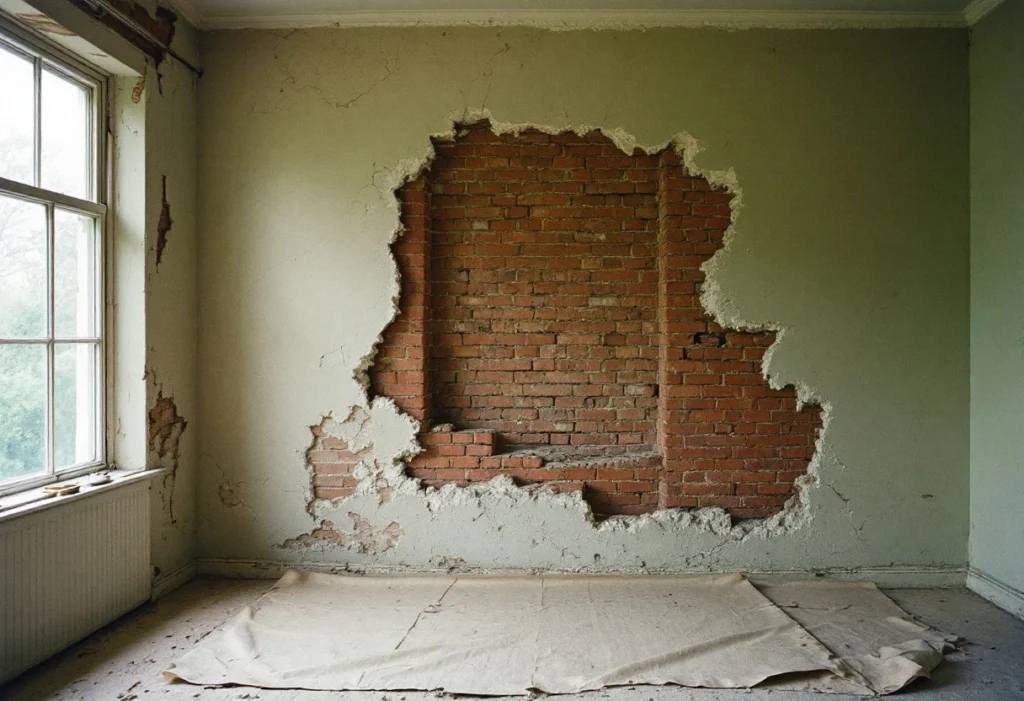
Two walls can look equally bad and need very different work. A wall with fine cracks and old patches may only need a new finish coat. A wall that sounds hollow or carries a tide mark needs more, and a skim laid over it will fail with the old plaster. The surface shows that something is wrong. What sits behind it decides the repair.
This guide sets out the common wall symptoms and their usual causes. It explains when a crack or damp patch needs assessment before anyone plasters, and compares the three repair routes. It cannot diagnose your wall. Where the cause may be structural or damp, the answer comes from an inspection, not from a page.
What do the common wall symptoms usually mean?
Hairline cracks. Fine cracks in the surface of otherwise sound plaster, often at corners, ceiling junctions and around openings. Historic England notes that cracks might not be a cause for concern, and that movement can be seasonal, driven by changes in temperature[1].
- Larger, diagonal or growing cracks. Cracks that widen, reopen after filling, run diagonally from the corners of windows and doors, or go through to the brickwork. These may come from movement in the wall itself, not just the plaster. They are the ones to have checked first.
Blown, hollow or bulging plaster. Plaster that has lost its bond with the wall behind. It sounds hollow when tapped and may bulge. British Gypsum uses tap-testing to find hollow areas before cutting back to solid material[2]. Poor adhesion to the surface beneath is one cause[2]. Moisture is another: gypsum plaster exposed to it repeatedly or for long periods can lose strength and adhesion[3]. If the wall itself looks bowed, not just its surface, treat that as a possible structural sign.
Damp patches, tide marks and salts. Common causes include overflowing gutters and drains, and outside ground levels that have built up above the floor or the damp-proof course. Poor ventilation adds condensation and mould. Salts carried in the moisture can harm plaster and paint[4].
- Uneven or heavily patched surfaces. Years of filled holes, removed fittings and repairs leave a wall that is sound but rough or out of flat. This is a finish problem, not a failure.
Failing old lime plaster. In older houses of traditional construction, the internal plaster would have been lime based. Later repairs in gypsum plaster, cement or modern paint may trap water in the wall[5].
Textured coatings need care. HSE lists textured decorative coatings, such as Artex, among the places asbestos can be found in homes. Asbestos can be present in any building built or refurbished before 2000[6]. Fibres are released when materials containing it are disturbed or damaged[7]. Do not sand, scrape or drill an old textured ceiling or wall until it has been identified. If a suspect material turns up during work, HSE's advice is to stop work immediately[7].
When does a wall need assessment before plastering?
Plastering covers a crack. It does not stop the movement behind it. Historic England notes that older houses can tolerate a degree of movement without serious problems. Its test is whether the movement is ongoing and threatens the use or safety of the structure. If you suspect it is, Historic England advises having a structural engineer who knows old buildings inspect it[1].
Subsidence is one reason for movement. The Planning Portal describes underpinning as the repair where the existing foundations have moved because of poor soil or changes to the soil, such as subsidence. The first step is generally a trial hole next to the footings, so that a structural engineer or surveyor can assess the case. Underpinning counts as building work under the Building Regulations and usually needs a structural design[8].
Damp works the same way. Where a building suffers from damp, mould or damage to decoration or structure, the Planning Portal notes that a damp-proof course may be needed to stop it getting worse[9]. Often the cause is simpler: a leaking gutter, a blocked drain, raised ground levels or poor ventilation[4]. Find and fix the cause, then let the wall dry, before any gypsum plaster goes back on[3].
Skim, re-plaster or dry line: which route fits?
Once the cause is dealt with, the state of the old plaster narrows the choice.
Three ways to repair a damaged wall
| Route | What is done | Suits | Rule it out when |
|---|---|---|---|
| Skim | A thin finish coat over the existing plaster. Thistle MultiFinish, for example, goes on 2 mm thick[3]. | Sound, well-bonded plaster that is cracked on the surface, patched, stained or rough | The plaster is hollow, loose, crumbling or damp, or the wall is badly out of flat |
| Hack off and re-plaster | Old plaster removed back to the masonry, then an undercoat and a finish coat. Thistle HardWall undercoat goes on 11 mm thick on walls and needs a finish coat before decorating[10]. | Large areas of blown or crumbling plaster, or plaster spoiled by damp that has now been cured | The cause of the damp or the movement has not been dealt with |
| Dry lining | Plasterboard fixed over the wall in place of new wet plaster. Boards come in standard, moisture-resistant, fire-resistant, acoustic and thermal types[11]. | Very uneven walls, or where a board with added performance, such as insulation, is wanted | An older solid wall relies on drying out and the moisture risk has not been assessed[12] |
Scroll sideways to see all columns
Skim over sound plaster
Because a skim is thin, it is only as good as the surface it sits on. British Gypsum lists insufficient adhesion to the surface beneath and moisture left in the skim among the causes of a skim coming away after painting[2]. So tap the whole wall first. Small hollow patches can be cut back to a firm edge and made good before the skim[2]. If hollow areas run across much of the wall, a skim is the wrong route.
Hack off and re-plaster
Re-plastering removes the failed layer and starts again from the masonry. An undercoat such as Thistle HardWall is made for medium to high suction backgrounds, including brick and aircrete block[10]. A finish coat follows. In an older house, this is the point to decide whether lime is the right material to go back.
Dry lining with plasterboard
Dry lining covers the old wall with plasterboard instead of new wet plaster. It can hide a wall that is badly out of flat, and boards are made with added fire, sound, moisture and thermal performance[11]. The boards are then jointed or skimmed. Thistle MultiFinish is suitable over plasterboard, but British Gypsum advises against skimming its moisture-resistant boards[3]. Fixing methods, board types and stud partitions are covered in our guide to dry lining and plasterboard options.
In the Building Regulations, renovation means a new layer or the replacement of an existing layer, not decorative finishes[13]. Where more than 50% of an external wall's surface is renovated, regulation 23 requires the whole wall to be brought up to the energy standard, in so far as that is technically, functionally and economically feasible[14]. Re-plastering or dry lining most of an outside wall can fall within that, so ask building control before the work is fixed.
When the cause is clear and the route chosen, get the price from someone who has seen the wall. Plastering can be booked with us as a standalone job. The site visit and the written quotation are free, and neither commits you to anything. You can get a plastering quote from our plastering service page.
What changes in an older house with lime plaster?
Older houses of traditional construction were built with natural materials that manage moisture without mechanical ventilation. Their internal plaster would have been lime based[5]. These plasters easily allow excess moisture to evaporate. Gypsum plaster, cement and emulsion or waterproof paints may trap water and stop the wall drying out. So avoid sealing an old solid wall with impermeable materials. Historic England recommends considering replacing such plasters with traditional materials such as lime plaster[5].
The same care applies to dry lining. Historic England says a building must be in good repair and free from excess moisture before wall insulation is installed. Unsuitable insulation can hinder natural drying and let moisture build up within the wall[12]. In a listed building, any significant change needs listed building consent[9]. Ask the council's conservation officer before choosing a route for a listed house.