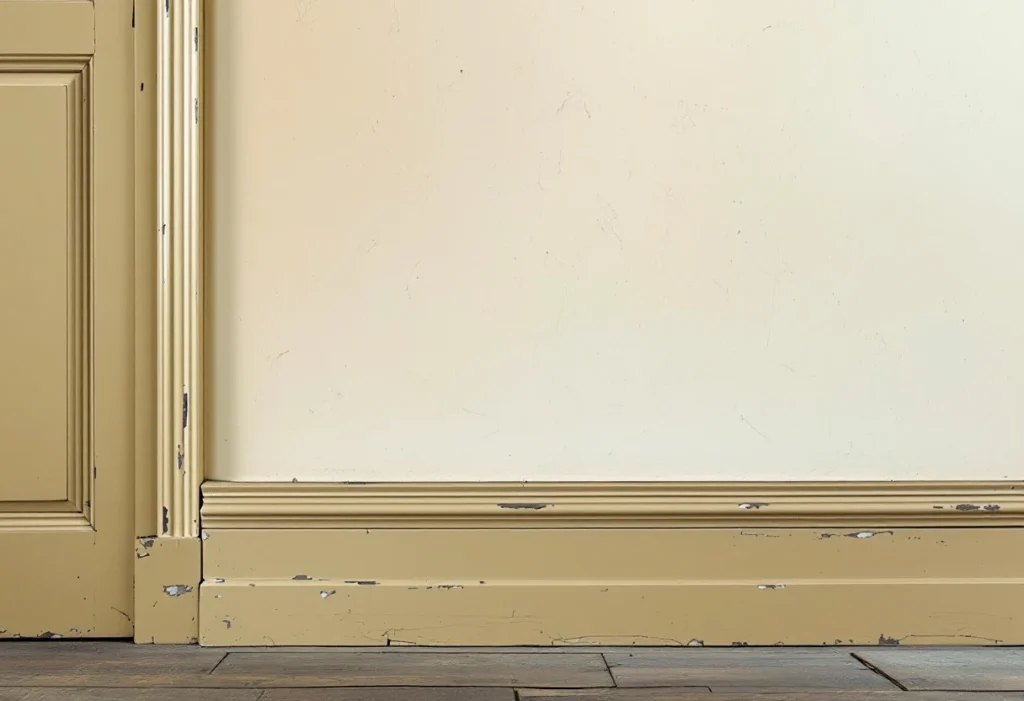
Decorating an older house is mostly the same job as decorating a new one, with two exceptions. The old paint may contain lead, which turns preparation into a health question, and the walls may be solid masonry with lime plaster, which affects what paint can go on them. This guide covers which houses may have lead paint, what not to do with it, why solid walls need breathable finishes, how to prepare lime plaster, and why a damp wall needs a diagnosis before a paintbrush. It describes safe principles; it gives no instructions for removing lead paint.
Which houses may have lead paint?
There is no single cut-off year, because lead was phased out over several decades:
Until the 1960s. HSE says lead pigments were widely used in paints for homes until the 1960s[3], and SPAB says lead paint might be present in nearly any pre-1960s building, particularly on timber and metalwork[6].
Into the 1980s. HSE says lead was not removed from all commonly used paint until the early 1980s, so it can be found underneath existing paintwork[3].
1992. The sale of lead paint was banned in the UK from 1992[2]. The British Coatings Federation advises testing painted surfaces if you suspect lead, especially when renovating a house built before 1995[5].
UKHSA notes that leaded paint may still be found in Victorian properties that have not been stripped, often below newer non-leaded paint, and that multiple coats in a property built before 1970 are an indication[1]. In practice, any house with paint layers older than the 1990s could have lead somewhere in them.
Why does lead paint matter?
Lead is harmful when it is breathed in as dust or fumes, or swallowed. UKHSA says pregnant women, infants and young children are particularly sensitive to its effects, and that children exposed in the first few years of life may have a lower IQ, behavioural problems or nerve damage[1].
The risk comes from disturbing it. UKHSA says that if lead paint is in good condition or has been redecorated, the lead should be sealed in, and exposure is only likely if the paint is removed or sanded during redecoration[1]. It also notes that people working in construction or renovation may bring lead into the home as dust on their clothes[1].
What not to do with old paint
The safest approach in official and industry guidance is to leave sound paint alone and paint over it. HSE's construction guidance favours leaving in place paintwork that is in good condition or covered by non-leaded paint, and stripping old paint only if it is flaking, chipping, giving off dust or is a risk to children[3]. SPAB says it could be safer to renew or overcoat lead paint than to attempt its removal, and that the presence of lead paint does not justify stripping out historic joinery[6].
HSE names the activities with the highest risk[4][16]:
- Burning off or blast-removing old lead paint.
- Stripping old lead paint from doors and windows.
- Stripping old paint with blow lamps or gas torches.
- Dry sanding old paint.
The British Coatings Federation's guidance for householders adds: don't remove paint that is sound, especially where the lead is not the top layer; don't let people who aren't involved stay in the room; don't use dry abrasive paper; and make sure no children or pregnant women are present where lead-containing surfaces are disturbed[5]. Where lead is confirmed, it suggests employing professional decorators[5].
Testing for lead
Home test kits exist, but the British Coatings Federation says a negative reading should not be relied on to show that lead is absent, and that a professional test should be carried out if you think lead could be present[5]. Test before any preparation that would disturb old layers.
If a child is found to have lead in their blood and the likely source is paint, UKHSA says the local authority's environmental health or housing department, or a housing association, may be able to take samples; for health concerns, speak to your GP or NHS 111[1].
Why do solid walls need breathable finishes?
Many older houses have solid walls of brick or stone, often finished inside with lime plaster. Walls like these take up moisture and rely on it evaporating again from their surfaces. SPAB's guidance on damp says attempts to seal walls with dense plasters, PVA or impervious paint impede that evaporation, trap or displace the moisture, and can lead to spalling or powdering of the surface[8].
SPAB names plastic-based paints among the inappropriate finishes on traditional solid walls[8]. It defines a breathable material as one that cannot be impermeable and should not trap moisture, and says it is reasonable to ask a manufacturer to validate any breathability claim[7].
Which finishes suit older walls?
SPAB says the factors to weigh are compatibility with existing finishes and the background, including breathability on solid walls, the exposure, and durability, and that historic formulations such as limewash and soft distemper frequently remain appropriate[10]:
Finishes for older solid walls
| Finish | Where it suits | What to watch |
|---|---|---|
| Limewash | Traditional solid walls, lime plaster and lime render; more tolerant of damp and extremely permeable[8] | Unsuitable on impervious materials such as flint or hard brick, and first-time limewashing is inadvisable on sandstone; takes less well to cement render, plasterboard or emulsion; typically renewed about every five years[9] |
| Soft distemper | An alternative to limewash when redecorating traditional solid walls[8] | Unsuitable on walls that remain damp[8] |
| Clay paint, renovation paint or contract emulsion | Walls already coated in less breathable vinyl emulsion[10] | Ask for the manufacturer's vapour-permeability figures[7] |
| Vinyl emulsion | Modern plaster and plasterboard | Less breathable; on old walls already coated with it, SPAB suggests clay paint, renovation paint or contract emulsion over it[10] |
| Plastic-based paints | Modern surfaces | Named by SPAB as inappropriate on traditional solid walls[8] |
Scroll sideways to see all columns
SPAB also notes that limewash is less successful in very fast-drying conditions, and that gloves and eye protection should be worn when using it[9]. Sound paint on old buildings is, in SPAB's words, preferably left undisturbed and appropriately painted over unless there are good reasons to remove it[10].
Preparing lime plaster
SPAB's advice is to deal with the cause of any defects first, including structural or damp problems, and it warns that old plasterwork is worth conserving but is often indiscriminately replaced with gypsum-based products[11]. It recommends selecting a paint that is vapour permeable, compatible with existing finishes and easy to reapply, and says lime plaster is preferable where repairs will be limewashed[11]. Repairs to old walls before decorating are part of plastering, and the right repair material depends on what the wall is made of.
Damp walls: find the cause first
Paint is not a cure for damp. SPAB says the cause of damp in old buildings is frequently misdiagnosed and ineffective, unnecessary treatments are often carried out[8], that true rising damp is rarer than commonly perceived, and that it is widely misdiagnosed on the basis of high electrical moisture-meter readings alone[12]. Government guidance on damp and mould says the underlying causes, including building defects, poor ventilation and condensation, have to be identified and tackled, because removing surface mould alone won't stop it coming back[13].
Historic England's advice is to check and fix anything that is causing or worsening damp, such as a cracked drainpipe, an overflowing drain or a lack of ventilation, and it warns that modern impervious materials, like cement-based fillings or impermeable coatings, can make an old wall decay even faster[18]. Once the source is dealt with, the wall needs time to dry before it is decorated, and a breathable finish lets it keep drying afterwards.
Listed buildings
Works that would affect the character of a listed building need listed building consent[14], and carrying them out without consent is an offence[17]. Changing historic finishes or stripping old paint can fall within that, so check with the council's conservation officer before starting. Lead paint itself may still be used in England on Grade I and Grade II* listed buildings, scheduled monuments and works of art, where it is needed to restore or maintain historic finishes, and it can be supplied only after a declaration to the competent body and a wait of at least 3 weeks[15].
Next steps
The site visit and the written quotation are free, and neither commits you to anything. For an older house, tell us roughly when it was built, which rooms or elevations need decorating, and whether any paint is flaking or any walls are damp. For how decorating is scoped and run, see our painting and decorating service.