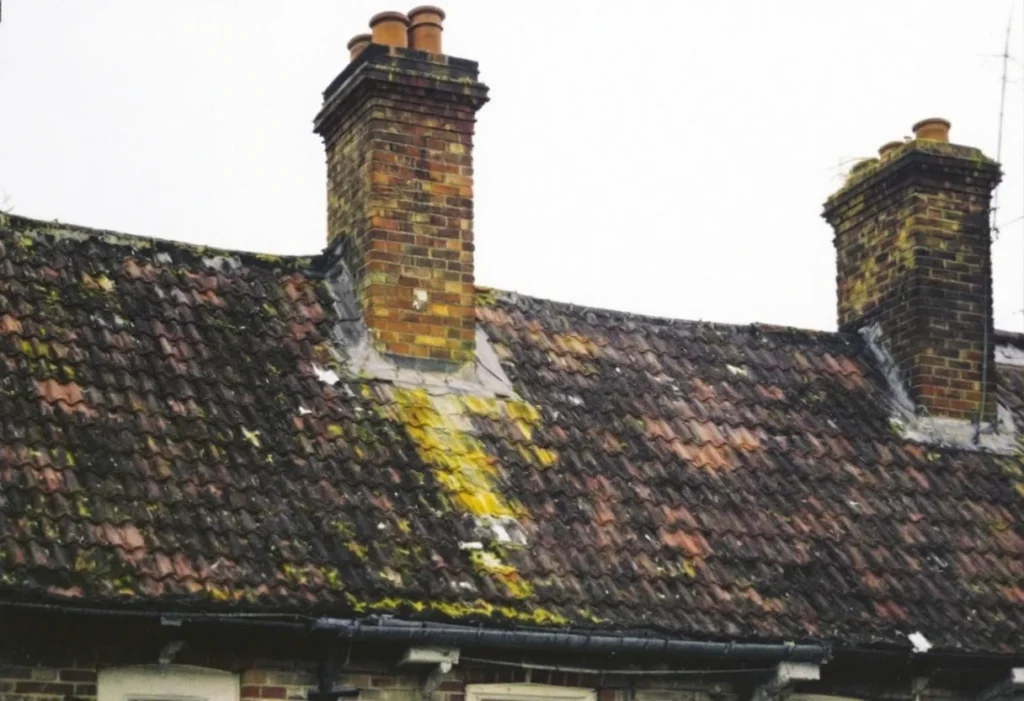
A roof rarely fails all at once. Water gets in at one point, often a flashing, a valley or a slipped tile, and the damage spreads from there into the battens, the timbers and the ceilings below. Fixing that point is a repair. When the same faults run across the whole roof, repairs stop holding and the covering needs replacing. This guide sets out the signs, how to tell a leak from condensation, when repair stops making sense, and what a roofer should check. It gives no advice on going onto a roof yourself.
Check from the ground, never from the roof
HSE says almost one in five deaths in construction work involve roof work, and that while some are specialist roofers, many are people just repairing and cleaning roofs[1]. The main causes are falls from roof edges and openings, and through fragile roofs and rooflights[1]. HSE advises treating all roofs as fragile until a competent person has confirmed they are not, and lists slates and tiles among the surfaces that may not support a person's weight[1][2]. It also notes that people doing small, short maintenance jobs are over-represented in fall-through injuries[2].
Everything in the list below can be seen from the ground, from an upstairs window, from a neighbour's garden or from inside the loft. Binoculars help with chimneys and ridges. Leave anything closer to a roofer with the right access equipment.
Signs to look for
On a pitched roof
- Slipped, cracked or missing tiles or slates. A single gap lets water onto the underlay and battens below. A few are a repair.
Slates slipping across a whole slope. On older slate roofs this is often nail fatigue, known as nail sickness: Historic England describes the nail heads decaying and weathering enlarging the nail holes until the slates start to slip[3]. Widespread slipping usually means stripping and refixing the slope.
Flashings. Historic England says flashings, usually sheet lead, weatherproof the junctions where the roof meets an abutment such as a chimney, and that these junctions are often the most vulnerable part of the roof[3]. Look for lead that has lifted, split or pulled out of the brickwork.
Valleys. Where two slopes meet, the valley carries the water from both. LABC Warranty's technical manual calls the valley the most vulnerable area of a pitched roof for water getting in[4]. Debris, moss or cracked valley tiles are worth having checked.
Ridges and verges. Loose or missing ridge tiles and cracked mortar at the verges. The current code of practice for slating and tiling, BS 5534:2014+A2:2018, no longer relies on mortar bedding to resist wind uplift[5], which affects how these are refixed.
- The roof line. A ridge that dips or a slope that bows can mean the timbers are overstressed or have decayed. That is a structural question rather than a roofing repair.
On a flat roof
- Splits, tears and cracks in the covering, especially at joints, edges and upstands where the roof meets a wall.
Water that stands after rain. NFRC's summary of the current flat roof code of practice, BS 6229:2025, says it sets a minimum finished fall of 1:80 for general roof areas[13][14]. Ponding can mean the falls were never right or that the deck has deflected.
- Soft or uneven areas seen from a window, which can mean wet insulation or a decayed deck under the covering.
Inside
- Stains on ceilings below a chimney, valley or flashing, that appear or spread after rain.
- In the loft, damp patches on the underside of the roof, on the timbers or on the insulation, and daylight showing through where the covering has gaps.
- Gutters that overflow in heavy rain, which can push water back under the eaves.
Leak or condensation?
Not every damp ceiling is a roof leak. Government guidance on damp distinguishes penetrating damp, which is water getting in from outside through defects in walls, roofs, windows or floors, from condensation, which is moisture produced inside the home and is one of the most common causes of damp and mould[6]. Telling the two apart is part of what a roofer or surveyor assesses, from where the damp is, when it appears and what the roof space is like.
Approved Document C says the condensation requirement is met in cold roofs by ventilating the roof space[7]. In its guidance on older buildings, it also advises sealing service openings in the ceiling, draught-proofing loft hatches and keeping loft insulation clear of the eaves so that ventilation isn't reduced[7]. Re-covering a roof that is actually suffering from condensation won't cure it.
When does repair stop making sense?
Historic England's advice is that keeping the rain out is the first priority, so act quickly if a roof needs repairing, but that replacing an old covering is disruptive and expensive, so first check whether it is repairable[3]. Repair is usually the answer for local faults. These point towards replacement:
The same fault across a whole slope, such as slates slipping everywhere from nail fatigue[3].
- Repeated leaks in different places, after earlier repairs.
- Tiles or slates that crumble or break as neighbouring ones are lifted, so that refixing one area damages the next.
Sagging or decay in the roof structure, which has to be checked and, where needed, strengthened. Approved Document A says that where checks show the existing structure can't take an increase in loading, for example because of overstressed members or deflection leading to ponding, the roofing members should be strengthened or replaced[8].
Replacing a large part of a roof brings in the Building Regulations. A roof is a thermal element, and regulation 23 says that renovating more than 50% of its surface, or a major renovation of the building, requires the whole roof to meet the energy efficiency standard where that is technically, functionally and economically feasible[9]. In practice that usually means upgrading the insulation when the roof is re-covered.
For an older house, Historic England recommends getting independent professional advice from an architect or surveyor with experience of old buildings before re-covering, and says that consent is needed to change the type of covering on a listed house[3].
Two things to rule out first
Asbestos. HSE says buildings built or refurbished before 2000 may contain asbestos, including asbestos cement roofs, and advises not to repair or remove asbestos materials without training[10]. Corrugated sheets on garages and outbuildings are a common example.
Bats. All bat species and their roosts are protected, and GOV.UK lists repairing or replacing a roof among the activities that can affect them[11]. If bats may be using the roof, a survey comes before the work.
Signs and what they usually mean
Roof signs and what they usually point to
| Sign | What it can mean | Usually points to |
|---|---|---|
| A few slipped or broken tiles | Local damage, often from wind or a failed fixing | Repair |
| Slates slipping across a slope | Nail fatigue on an older slate roof[3] | Stripping and refixing the slope |
| Stain below a chimney or abutment | Failed or lifted flashing[3] | Repair |
| Leak where two slopes meet | Blocked or damaged valley[4] | Repair, or relaying the valley |
| Water ponding on a flat roof | Inadequate falls or a deflected deck[8][14] | Assessment of the deck and falls |
| Sagging ridge or bowed slope | Overstressed or decayed timbers[8] | Structural check, then repair or replacement |
| Damp spread over a cold loft | Possibly condensation rather than a leak | Checking the roof space ventilation before re-covering[7] |
| Leaks in several places after repairs | A covering at the end of its life | Replacement |
Scroll sideways to see all columns
What a roofer should check
A useful inspection covers more than the visible fault. Ask for it to cover:
- The covering: tiles or slates, their fixings, and whether the problem is local or across the slope.
- Flashings, valleys, ridges, verges and the chimney.
- The roof space from inside: the underlay, battens, timbers, insulation and any signs of condensation.
- Gutters, fascias and downpipes.
- On a flat roof, the covering, upstands, outlets and the falls.
- Whether the roof needs a structural engineer, an asbestos check or a bat survey before work.
NFRC's homeowner guidance is to get quotes in writing, except perhaps for small emergency repairs, and to bear in mind that estimates for refurbishment can change once the main covering is removed and the structure underneath is exposed[12]. A quote should say what has been seen and what is assumed. With an E&N Build Group quotation you get a written scope before work starts, stating what is included and what is provisional until the covering is off.
Next steps
The site visit and the written quotation are free, and neither commits you to anything. The enquiry asks for the postcode, the type of work and a short description; for a roof, say whether it is pitched or flat, what you have noticed, and send any photos taken from the ground. For how roof work is scoped and run, on its own or with other building work, see our roofing service.