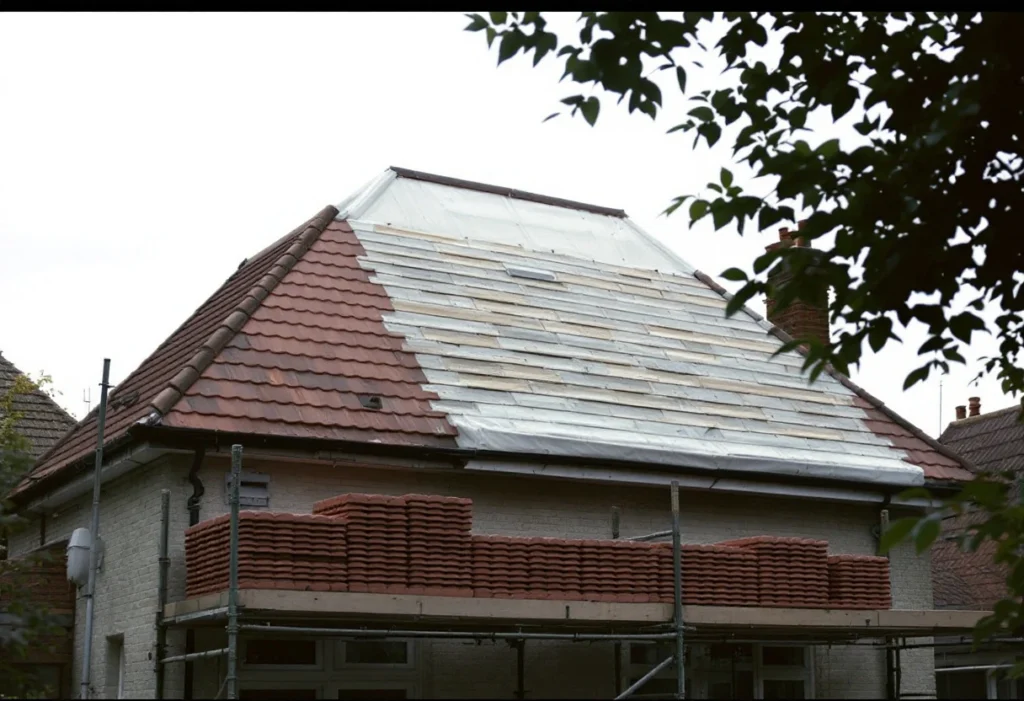
A roof replacement is priced in layers: the covering you see, the battens, underlay and insulation under it, the flashings and gutters around it, the scaffold that gives access, and the repairs that only show once the old covering is off. Two quotes for the same house can differ because one includes layers the other leaves out. This guide covers the stages of re-roofing, the cost drivers, the costs outside the roofing work, VAT and what a quote should say. It gives no price ranges, for the reason below.
Why there is no standard roof price
Roofs are often talked about as a price per square metre. That figure leaves out what changes most between jobs: the roof's shape, the scaffold, the condition of the timbers and the insulation the Building Regulations require. A reliable figure is priced against an inspection and a written scope.
What does re-roofing involve?
Access. Scaffolding is put up, with a licence if it stands on the pavement or road[5][6].
Strip-off. The old covering, battens and underlay come off, and the waste is removed[8].
Inspection of the structure. Rafters, wall plates and the deck are checked once exposed, and repaired or strengthened where needed[2].
Underlay, battens and ventilation. New underlay and battens go on, with ventilation designed to control condensation[4].
- The covering. Tiles, slates or a flat roof membrane are laid and fixed.
- Details. Ridges, hips, valleys, verges and flashings at chimneys and walls are made watertight.
Insulation and sign-off. Insulation is upgraded where the rules require it, and the work is certified or inspected[3][12].
What drives the cost of a new roof?
The covering material
Slate, clay tile, concrete tile and flat roof membranes differ in material cost, laying time and weight. Weight matters for the structure: the Planning Portal says that if the new covering is significantly heavier or lighter than the existing one, the roof structure may need modifying or strengthening, and advises checking with a structural engineer or surveyor before starting[1]. Approved Document A treats an increase in roof loading of more than 15% as significant[2].
Size, pitch and shape
A simple pitched roof with two slopes is the quickest to cover. Hips, valleys, dormers, chimneys and rooflights all add cutting and detailing, and steep or very high roofs take longer to work on safely.
Scaffolding
Re-roofing generally needs scaffolding along the eaves for safe access. Where it stands on the highway, including the pavement, it needs a licence in writing from the highway authority[5]. GOV.UK says the builder or scaffolding company gets the licence, and the householder should check they have it and that it won't run out before the work is finished[6]. Terraced houses with no side access, or scaffolds that have to bridge a conservatory or extension, take more time and material.
Timber and structural repairs
Rotten rafter feet, decayed battens or a sagging structure are often found only once the covering is off. Approved Document A says that where checks show the existing roof structure can't take an increase in loading, for example because members are overstressed or deflect enough to cause ponding, the members should be strengthened or replaced[2]. NFRC warns homeowners that estimates for refurbishment can change once the main covering is removed and the structure underneath is exposed[15].
The insulation upgrade
A roof is a thermal element. Where more than 50% of its surface is renovated, regulation 23 requires the whole roof to meet the energy efficiency requirements, where that is technically, functionally and economically feasible[3]. Approved Document L's examples for renewing a roof covering give a target U-value of 0.16 W/m²K: for a loft with no rooms in it and little or poor existing insulation, by adding loft insulation at ceiling level, and for rooms in the roof, by insulating at rafter level[4]. The same guidance says to assess condensation risk in the roof space and make provision for it[4], which can mean adding ventilation. Rooms in the roof can cost more to upgrade than an empty loft.
Flashings, chimneys and rainwater goods
Lead flashings, chimney repairs, fascias, soffits and gutters are often renewed at the same time, because the scaffold is already up. Each is a separate line in a quote, and leaving them out can make one price look lower than another.
Waste, asbestos and wildlife
Waste. Government guidance says a tradesperson is responsible for the waste they produce, and the cost of disposal should be included in what they charge[8]. A skip on the road needs the highway authority's permission[7].
Asbestos. HSE says buildings built or refurbished before 2000 may contain asbestos, including asbestos cement roofs, and that intact asbestos cement sheets should not be broken up[9]. Removal, where needed, is an extra cost.
Bats. Repairing or replacing a roof is one of the activities that can affect bats, which are protected; a survey, and a licence if harm can't be avoided, add cost and time[10].
What sits outside the roofing price?
Building control. Where an application is made, the fee is set by each local authority under its own charging scheme[11].
A scheme certificate instead. A roofer registered with a competent person scheme for roof coverings, currently NAPIT or CompetentRoofer, can self-certify the work instead[12].
Structural engineer. Calculations if the covering is heavier or the structure needs strengthening[1].
Surveys. A bat survey or an asbestos survey, where needed[9][10].
Roof cost drivers and what they add
| Driver | What it adds | Where it comes from |
|---|---|---|
| Heavier covering | Structural check, possibly strengthening | Approved Document A, more than 15% more load[2] |
| More than half the roof re-covered | Insulation upgrade and condensation provision | Regulation 23 and Approved Document L[3][4] |
| Scaffold on the pavement | Highway licence | Highways Act 1980, section 169[5] |
| Skip on the road | Highway authority permission | Highways Act 1980, section 139[7] |
| Rotten timbers found | Repair or replacement of roof members | Found once stripped[2][15] |
| Asbestos cement | Specialist handling or removal | HSE guidance[9] |
| Bats in the roof | Survey, timing, possibly a licence | Wildlife law[10] |
Scroll sideways to see all columns
What should a roofing quote include?
NFRC's advice to homeowners is to get the quote or estimate in writing, except perhaps for small emergency repairs, not to automatically take the cheapest option, and to agree payment terms before the work starts[15]. It also reminds owners that they are responsible for any planning permission the property needs[15]. A quote that can be compared should state:
- The covering, underlay, battens and fixings, and how much of the roof is included.
- Flashings, valleys, ridges, chimney work, fascias and gutters, either included or excluded.
- The insulation and ventilation work, and how the roof will be certified or inspected.
- Scaffolding, the licence, waste and skip.
- What is provisional until the covering is off, and how it will be priced.
Setting several quotes side by side is covered in comparing building quotes. With an E&N Build Group quotation you get a written scope before work starts, stating what is included, what is not, and what is provisional.
How does VAT apply to a new roof?
VAT is charged only by VAT-registered businesses, and the standard rate is 20%[18]. HMRC says work to an existing building is normally standard-rated[13]. Two exceptions can matter for a roof:
Renovating an empty home. The 5% rate can apply where the home has not been lived in during the 2 years immediately before work starts, and it covers repair and maintenance carried out during that renovation; scaffolding and professional fees stay standard-rated[13].
Insulation. Installing energy-saving materials in homes, which includes insulation for roofs and lofts, is zero-rated until 31 March 2027, then reverts to 5%[14]. Where insulation is installed alongside other work, HMRC says you must decide whether the job is a single supply, at one rate, or several supplies at different rates; its example of insulating an extension as part of building it is a single standard-rated supply[14]. How a re-roofing contract is treated depends on how it is set up and invoiced, so ask for the VAT treatment in writing.
Cancelling a contract signed at home
If you sign a roofing contract in your own home, you usually have 14 days to cancel it[17]. The right doesn't apply where you specifically asked the trader to visit to carry out urgent repairs or maintenance[16]. Citizens Advice notes that if you asked for work to start within the 14 days, you might have to pay for some or all of it if you then cancel[19].
Next steps
The site visit and the written quotation are free, and neither commits you to anything. For a roof, tell us whether it is pitched or flat, what it is covered in, whether there are rooms in it, and what you have noticed. For how roof work is scoped and run, see our roofing service.