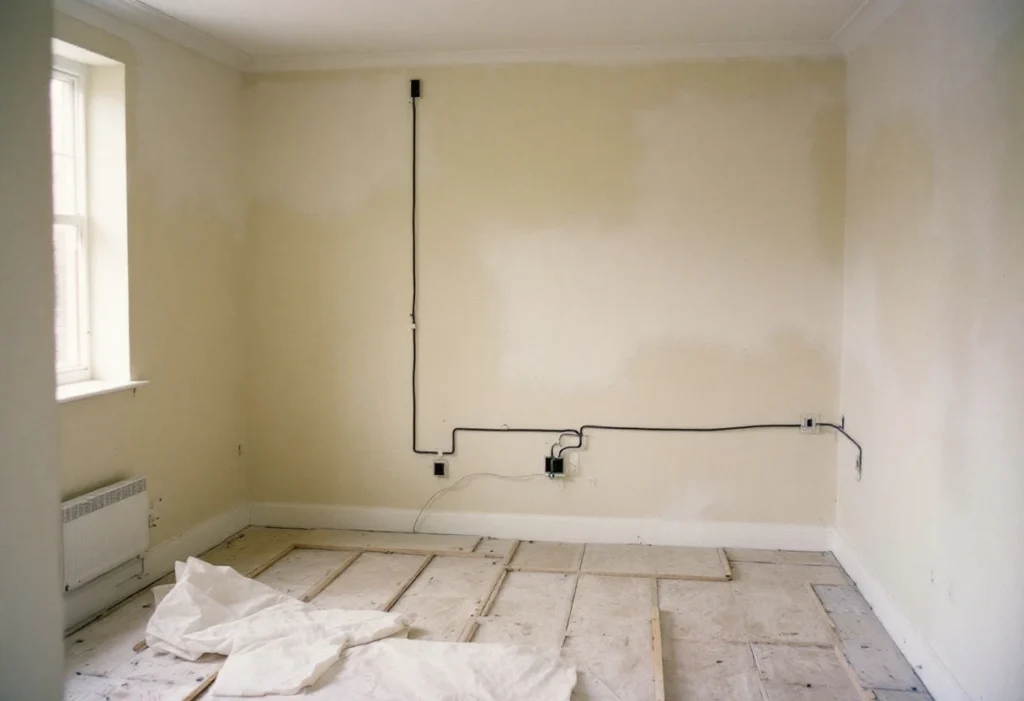
Two houses of the same size can cost very different amounts to rewire. In one, the rooms are empty and the walls are being replastered anyway. In the other, the family is at home, the ground floor is solid and the decoration is new. This guide covers the work, the cost drivers, the disruption, the certificates and VAT. It gives no price ranges, for the reason below.
Why there is no standard price for a rewire
A count of bedrooms or points does not price a rewire. It says nothing about how hard the cable routes are to reach, or what the outbuildings, alarms and plaster need. Electrical Safety First notes that a full rewire can be expensive, and advises home buyers to check what is needed before agreeing a purchase price[1]. A reliable figure is priced against a room-by-room plan and a written scope.
Full or partial rewire: what is the difference?
A full rewire replaces every circuit in the installation: the cables, the back boxes and the accessories, from the consumer unit to the last light. A partial rewire replaces or adds some circuits and leaves the rest in place. Examples are the lighting circuits only, one floor, or a new extension.
The choice rests on the condition of what is there. Electrical Safety First says there are no set guidelines for when a property should be rewired, and that old wiring is not necessarily unsafe[2]. It recommends a periodic inspection at least every 10 years in an owner-occupied home[2]. It also says electrics more than 50 years old should be checked and updated[1]. The inspection report shows which circuits are sound, which gives a basis for choosing between a full and a partial rewire.
Full and partial rewires compared
| Point to compare | Full rewire | Partial rewire |
|---|---|---|
| Scope | Every circuit, with new cables, back boxes and accessories | Selected circuits, rooms or floors; the rest stays as it is |
| Consumer unit | Often replaced at the same time. A new or replacement unit is notifiable[3]. | May stay if it suits the new circuits. A replacement is notifiable[3]. |
| Notifiable under Part P (England) | Yes: it installs complete new circuits[3]. | Yes if it installs a complete new circuit or a new consumer unit, or alters circuits around a bath or shower. Otherwise not[3]. |
| Disruption | Every room: floorboards lifted, walls chased, power off at times | Limited to the rooms on the affected circuits |
| Old wiring left behind | None | The circuits left in place keep their age and condition |
| Certificate | Electrical Installation Certificate for the new installation[4]. | Electrical Installation Certificate or Minor Works Certificate, for the work done[4]. |
| Often suits | Wiring found unsatisfactory throughout, or a house being fully renovated | Sound wiring with problems confined to some circuits, or new rooms being added |
Scroll sideways to see all columns
What does a rewire involve?
Cables go in before the walls are made good, and the accessories go on after the plaster is dry. A quotation should account for each stage, as included work or as an exclusion.
1. Survey and design
The electrician agrees where every socket, switch, light and alarm will go, and how many circuits the house needs. This is the point to add sockets, outside lights or an outbuilding supply, rather than opening finished walls later. If the work is notifiable and the installer is not registered with a competent person scheme, it must be notified before it starts[5].
2. First fix: cables and back boxes
First fix is the work done before the walls are closed up. Floorboards are lifted to run cables under suspended floors, and cables for the upstairs lights go through the loft. Walls are chased, meaning a channel is cut into the plaster, to take cables to sockets and switches. New back boxes are set into the walls.
Asbestos can be present in any building built or refurbished before 2000[6]. HSE lists textured decorative coatings such as Artex, and asbestos insulating board behind fuse boxes, among the places it occurs in houses[7]. Chasing or drilling through either would disturb it. If suspect material is found, work stops at once[6].
3. The consumer unit
The consumer unit holds the circuit breakers and protective devices for each circuit. Installing a new or replacement consumer unit is notifiable work in England[3]. Whenever electrical work is done, the electrician must check that the earthing and bonding arrangements are up to the required standard[8].
4. Making good
Chases are filled and plastered, and floorboards are refixed. Making good can stop at filling the chases, or it can run to replastering whole walls and redecorating. The written scope should say where the electrical work stops and the plastering and decoration start.
5. Second fix: accessories
Once the plaster is dry, sockets, switches, light fittings and alarms are fitted to the back boxes and connected. Supplies to a cooker, a shower or an outbuilding are connected at the same stage.
6. Testing and certification
The new installation is inspected and tested in line with BS 7671, the wiring regulations[9], and the results go on the certificate.
What drives the cost of a rewire?
Each driver changes how much work there is, or how much is unknown when the job is priced.
- House size and number of circuits. More rooms mean more points, longer cable runs and possibly more circuits for the consumer unit to serve.
- Occupied or empty. Working around furniture and a household takes longer than working in empty rooms, and power may need to stay on in part of the house each evening.
- Access under floors and in lofts. Suspended timber floors and an open loft give routes for cables. Solid floors, fixed floor finishes and boarded lofts leave fewer, so more of each run goes into the walls.
- Making good and decoration. Filling chases is one level of work. Replastering whole walls and redecorating is another, and may be priced by a separate trade.
Consumer unit and earthing. A replacement consumer unit[3], or earthing and bonding that falls short of the required standard[8], adds to the scope.
- Extra sockets and lighting. Each extra point is another back box, cable run and connection.
Smoke and heat alarms. Electrical Safety First advises a minimum of one smoke alarm on each floor, with a heat detector in the kitchen[2]. Alarm cables are easiest to run while the floors are up.
Outbuildings and gardens. Part P covers installations in outbuildings such as sheds, detached garages and domestic greenhouses, and fixed lighting and pond pumps in gardens[9]. A new circuit to a garden building is notifiable[3].
- What the work uncovers. Suspect asbestos, damaged joists or loose plaster stay hidden until the work opens up, so a fair quote shows them as provisional.
How disruptive is a rewire?
A full rewire touches every room. Floorboards come up, walls are chased, and dust spreads unless rooms are sheeted and sealed. Power is off for parts of the work, including while the consumer unit is changed, and furniture has to move off the floors being lifted. A partial rewire limits this to the rooms on the affected circuits.
So a rewire belongs before new plastering, decoration and floor finishes, not after them. The chases are then made good once, and new floors go down over finished cable runs. On an E&N Build Group job, work is carried out in the order the trades need: structure, then services, then finishes. Whether you can stay in the house during the work depends on the job, and we say so at the site visit.
What certificates should you get after a rewire?
A full rewire installs complete new circuits, and in England that makes it notifiable work under Part P of the Building Regulations[3]. Electrical Safety First notes that the regulations apply to changes to existing installations, including rewiring[4]. Either an installer registered with a competent person scheme does the work and self-certifies it, or it is notified before it starts to a building control body or, in England, a registered third-party certifier[5].
From a registered electrician you should receive an Electrical Installation Certificate, confirming the work meets BS 7671, and a Building Regulations Compliance Certificate, confirming it meets the Building Regulations[4]. Where the work went through building control instead, building control issues a completion certificate or a final certificate[9]. A competent person scheme certificate is evidence of compliance, and it shows up in solicitors' searches when you sell[10]. For what each document covers, and how they differ from a condition report, see the certificates issued after a rewire.
What a rewire quote should include, and what sits outside it
A rewire quotation should list the circuits and points room by room, and say whether it includes:
- the consumer unit, and any earthing and bonding work
- smoke and heat alarms
- lifting and refixing floorboards and floor finishes
- filling chases, replastering and redecoration
- supplies to outbuildings, outside lights and garden equipment
- testing, certification and any building control notification
Some costs sit outside the electrician's price. Work notified to building control, rather than self-certified, carries a building control fee. Local authorities base their fees on their costs, and private registered building control approvers negotiate theirs with you[11]. Checking suspect asbestos, and any removal, is a separate cost.
With an E&N Build Group quotation you get a written scope before work starts. It states what is included, what is not, and what is provisional because it cannot be known until the work opens up.
How does VAT apply to a rewire?
Most work on houses and flats by builders and similar trades is charged at the standard rate of 20%[12]. HMRC's VAT Notice 708 says work to an existing building is normally standard-rated. Builders charge VAT on the materials they supply and fit at the same rate as their work[13]. Lower rates apply only in narrow cases:
Renovating an empty home. The 5% rate can apply where the building has not been lived in for the 2 years immediately before the work starts[13].
Conversions. The 5% rate can apply to converting a building into a house or flats, or from one residential use to another[12][13].
Work for disabled people. Some work for disabled people in their home is zero-rated[12].
Each case has further conditions. If you think one applies, ask for the rate in writing before you accept a quote.
Next steps
Before asking for quotes, gather any condition report or certificates, and list the rooms that need more sockets or lighting. A photo of the consumer unit helps whoever prices the job.
The site visit and the written quotation are free, and neither commits you to anything. The enquiry asks for the postcode, the type of work, a short description and whether drawings exist. Coverage is London, Surrey and surrounding counties, confirmed for each project from the postcode. Electrical work can be booked as a standalone job. At handover you receive the certificates and sign-offs that apply to the work done. For how the work is run, see our electrical service.