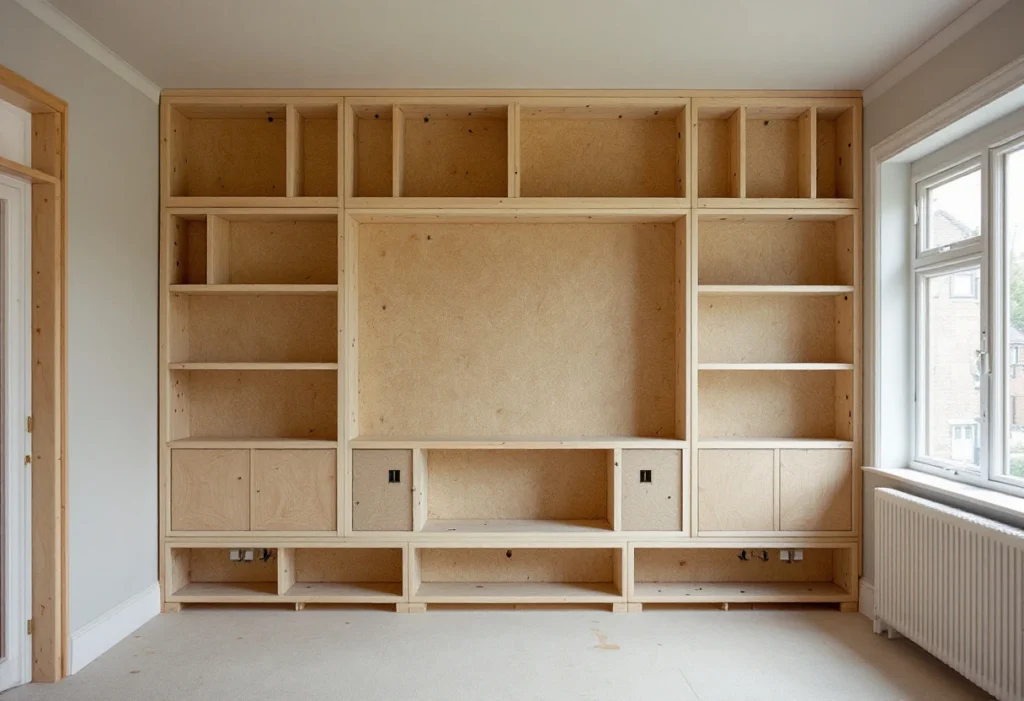
A media wall looks like joinery, but much of what makes it work is electrical. The TV, soundbar, fire and shelf lighting all need power inside a frame that is boarded over once built. So the electrics are the part to plan first.
This guide covers the electrical work a media wall usually involves and which parts are notifiable under Part P in England. It explains how notifiable work is approved, the certificates you should receive, and what happens if an old gas fire has to come out. Wales has its own list of exceptions[3].
What electrical work does a media wall involve?
The details depend on the design, but the same items come up again and again. Each can have a different answer under Part P.
Sockets behind the TV. A TV, soundbar, set-top box and console need several plugs between them. If you regularly rely on extension leads and adaptors, Electrical Safety First suggests having more wall sockets installed[7]. A media wall is a natural time to do it.
- A supply for an electric fire. A built-in electric fire needs its own supply, often a fused spur. The maker's installation instructions set the supply and the clearances, and the clearances fix the size of the recess.
- Lighting. LED strips in shelves and recesses run from a driver, a small power unit that sits in the frame. Downlights in a bulkhead are another choice. Either way, the lighting is added to an existing circuit or given a new one, and that decides whether it is notifiable.
- Aerial, data and AV cables. Aerial, network and HDMI cables are not mains wiring, but they share the routes through the frame. A conduit from the TV down to the cabinet lets leads be changed later.
Sometimes, a new circuit or consumer unit. If the existing circuit cannot take the load, or the board has no space, the electrician may propose a new circuit or a replacement board. Both are notifiable[1].
Which parts are notifiable under Part P?
Part P is the part of the Building Regulations that covers electrical safety in homes. It requires reasonable provision in the design and installation of electrical installations, to protect the people operating, maintaining or altering them from fire or injury[4]. All electrical work should follow BS 7671, the wiring regulations[1]. Only some of it has to be notified. Regulation 12(6A) of the Building Regulations 2010 identifies three kinds[3]:
- the installation of a new or replacement consumer unit;
the installation of a complete new circuit, such as a ring or lighting circuit[1];
alterations to existing circuits in a special location, which in England means the space around a bath or shower[1].
The special location runs from the floor to 2.25 metres high, or to the shower head if that is higher. It extends 0.6 metres out from the edge of the bath or shower tray[4]. A room with a swimming pool or sauna heater also counts[4]. A TV wall in a living room is outside it; one on a bathroom wall may not be.
Additions or alterations to existing circuits outside special locations are not notifiable[1]. That does not mean unregulated. Non-notifiable work should still be designed, installed, inspected, tested and certificated in accordance with BS 7671[4]. The table applies this to a media wall.
Media wall electrics under Part P in England
| Item | Notifiable? | What you should receive |
|---|---|---|
| Extra sockets behind the TV, added to an existing circuit | No, unless they are in a bath or shower special location[1] | A Minor Works Certificate[3] |
| A fused spur for an electric fire, taken from an existing circuit | No, unless it is in a special location[1] | A Minor Works Certificate[3] |
| LED strips or downlights added to an existing lighting circuit | No, unless they are in a special location[1] | A Minor Works Certificate[3] |
| A new circuit for the wall, the fire or the lighting | Yes[4] | An Electrical Installation Certificate, plus a Building Regulations compliance certificate or a building control completion certificate[2][4] |
| A new or replacement consumer unit | Yes[4] | An Electrical Installation Certificate, plus a Building Regulations compliance certificate or a building control completion certificate[4][6] |
| Aerial, network and HDMI cabling | Not one of the three notifiable kinds of work[3] | Ask for a marked-up note of the cable routes |
Scroll sideways to see all columns
How is notifiable work approved?
Approved Document P sets out three procedures: self-certification by a registered competent person, third-party certification by a registered third-party certifier, and certification by a building control body[4]. For most homeowners it comes down to the first or the last.
1. A registered competent person self-certifies
An electrician registered with a competent person scheme authorised by the Secretary of State self-certifies that notifiable work is safe and complies with the Building Regulations. You do not need to notify a building control body[2], and you do not pay building control charges[5]. Within 30 days of completion, the electrician arranges your Building Regulations compliance certificate and has the local authority notified for its records. You should also get a completed Electrical Installation Certificate[2].
2. Building control is notified before work starts
If the installer is not registered and has not appointed a registered third-party certifier, they must notify a building control body before work begins. The body decides how much inspection and testing it needs. When it is satisfied, it issues a completion certificate, or a final certificate if a private approver was used[4]. Because the notice must come first, this route has to be chosen before any wiring starts.
What certificates should you receive?
Two kinds of paper matter. The electrician's certificate confirms the work meets BS 7671: an Electrical Installation Certificate or a Minor Works Certificate. For notifiable work, a Building Regulations compliance certificate confirms it meets the Building Regulations as well[5].
Electrical Installation Certificate. A registered installer should complete one for every job they self-certify[4], such as a new circuit or consumer unit.
Minor Works Certificate. For smaller, non-notifiable work, such as a socket or spur added to an existing circuit. It shows the electrician has tested the work to make sure it is safe[3].
Building Regulations certificate. The compliance certificate on the self-certification route[2], or the completion or final certificate on the building control route[4].
An online registration is not a substitute. Asked about a new fuse box 'registered online' with no certificate, Electrical Safety First's answer was to ask for the Electrical Installation Certificate and to expect a Building Regulations compliance certificate too[6]. At handover on an E&N Build Group job, you receive the certificates and sign-offs that apply to the work done. Part P and electrical certificates explained sets out how these differ from a condition report.
What else applies when cables go into the wall?
Other parts of the Building Regulations touch the electrics too. Approved Document P names Part A on the depth of chases in walls, Part B on the fire resistance of service penetrations, and Part E on their soundproofing[4]. These matter most when a media wall is fixed to a party wall or a fire-separating wall.
Back boxes in fire-separating walls. Where flush sockets go into both faces of a 30-minute fire-separating plasterboard wall within the same cavity, each should have a back box with integral fire protection or a proprietary fire protection pad. Where cables pass through a fire-resisting element, the hole should be made good with a sealant that has intumescent properties[9].
Downlights in a bulkhead. Downlighters and their transformers must not be covered by thermal insulation[9].
Cable routes and fixings. Cables buried in walls are required to run horizontally or vertically from the socket or switch they serve[8]. A bracket fixed in line with an outlet can hit one, so photograph the routes before the frame is boarded.
What if a gas fire has to come out first?
Some media walls go where a gas fire used to be. Taking the fire out and capping its supply is gas work, not electrical work. By law, anyone carrying out work on gas appliances and fittings as part of their business must be competent and registered with Gas Safe Register. The Register's advice is never to try to remove a gas appliance yourself. It is illegal for someone unregistered to do gas work and then have it checked by a registered engineer[10].
Ask to see the engineer's Gas Safe ID card when they visit[10]. This guide does not describe how a supply is capped, because that is reserved work. On our jobs, gas work is arranged through a subcontracted gas engineer, and the framing and wiring follow in the order the trades need.
Common problems with media wall electrics
Too few sockets. Do not plug one extension lead into another, or overload a lead beyond its rating, which is 13A on most leads[7]. More outlets in the wall is the fix.
A new circuit treated as minor work. A new circuit is notifiable[1], so it needs a Building Regulations certificate, not only a Minor Works Certificate[2][4].
The bathroom wall. Lighting or a TV close to a bath or shower can fall inside the special location, making even a small addition notifiable[4].
- A buried driver. An LED driver boarded in with no access means cutting the wall open if it fails. Plan a cabinet or removable panel.
No RCD. An RCD switches off the power quickly if there is a fault[8]. If the board has none, the electrician may suggest a replacement, which is notifiable[1].
Next steps: plan the electrics with the wall
Settle the layout before the first stud goes up: the TV, soundbar and fire, where the boxes live, and what the lighting does. The electrician can then say which items join existing circuits and which need a new one. That decides the route and the certificates. Ask for it in writing.
With E&N Build Group, a media wall, or the electrical work on its own, can be booked as a standalone job. The site visit and the written quotation are free, and neither commits you to anything. The quotation comes with a written scope stating what is included, what is not, and what is provisional until the work opens up. See our media wall installation for what the build itself covers.