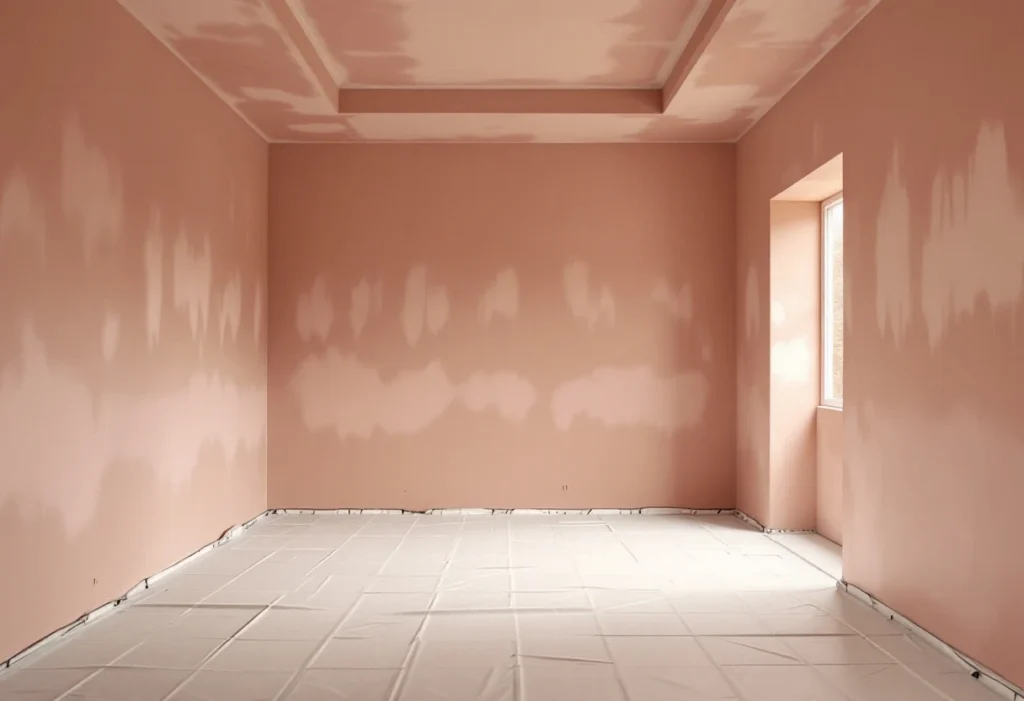
Two plastering quotes for the same room can differ for good reasons. One may cover a skim over sound walls. The other may include hacking off loose plaster, an undercoat, new beads and a skip. This guide covers what a job includes, the cost drivers and VAT. It gives no price ranges, for the reason below.
Why a price per room or per square metre misleads
A price per room assumes that rooms are alike, and they are not. Two bedrooms with the same floor area can differ in ceiling height, in the number of windows and doors, and in whether the ceiling is included. One may need a skim and the other a full re-plaster.
A rate per square metre is closer, but area is only one measure. Corners, reveals and beads are measured by length. Hacking off, boarding, protection and waste may sit outside the rate. A small job carries much of the same setting up and clearing as a larger one, so its cost per square metre is higher.
The state of the wall matters most. On British Gypsum's figures, a bag of its Thistle MultiFinish skim plaster covers about 10 m² at 2 mm[1]. A 25 kg bag of its Thistle HardWall undercoat covers about 3 m² at 11 mm, and still needs a finish coat[2]. So the same wall can need several times the material, plus the labour of stripping it first.
What does a plastering job include?
Most jobs follow the same stages, and which ones your rooms need sets the price:
- Assessment. Each wall and ceiling is checked: skim, re-plaster or board.
- Protection and clearing. Floors, stairs and fittings are covered and furniture moved.
- Preparation. Blown plaster is hacked off and the background treated so the new plaster bonds.
- Beads and boards. Corner beads go on and any plasterboard is fixed.
- Plastering. An undercoat where needed, then a finish coat.
- Waste and drying. Rubble is taken away, and the plaster dries before decoration.
The written scope should say which of these stages are included, which are left to you, and whether decoration follows.
What drives the cost of plastering?
Each driver below changes the material, the labour or the time the job takes.
Skim, re-plaster or board first
This is the largest single driver. A skim is a thin finish coat over a sound surface. British Gypsum gives 2 mm for its MultiFinish, over plasterboard or other flat surfaces treated with a bonding agent[1]. A re-plaster means hacking off to the masonry, then an undercoat and a finish coat[2]. Boarding first means fixing plasterboard, then skimming it. The guide on whether a cracked or blown wall needs a skim, re-plaster or plasterboard explains how the choice is made.
How the three routes differ
| Route | What it involves | Plaster layers (manufacturer's figures) | What adds time and cost |
|---|---|---|---|
| Skim coat | A finish coat over sound plaster or new plasterboard | About 2 mm of finish plaster[1] | Filling cracks; a bonding agent on flat, low suction surfaces[1] |
| Re-plaster | Hacking off blown or loose plaster, then two coats | Undercoat of about 11 mm on walls or 8 mm on ceilings, then a finish coat[2] | Stripping, waste, a second coat and longer drying |
| Board and skim | Plasterboard fixed over the old surface or to a frame, then skimmed | Plasterboard, then about 2 mm of finish plaster[1] | Fixing and jointing boards, corner beads, and working around sockets, switches and reveals |
Scroll sideways to see all columns
Ceilings or walls
Ceilings are usually priced apart from walls. The work is overhead and needs a working platform. The room below has to be cleared or covered, and light fittings come down first. HardWall goes on at 8 mm on a ceiling against 11 mm on a wall[2].
The condition of the background
The background is whatever the plaster bonds to: brick, block, old plaster or board. Blown plaster has come away from the wall behind and sounds hollow when tapped. A skim over it would sit on a loose base, so it usually comes off. How far it runs is often unknown until hacking starts, so a fair quote marks it as provisional.
Painted, tiled and very smooth surfaces usually need treating first. British Gypsum's Bonding 60 data sheet lists painted and tiled surfaces, dense blocks, plasterboard and concrete among the backgrounds for which it recommends pre-treatment[3].
Old lime plaster in older houses
Historic England lists lime and earth plasters among the traditional finishes of older buildings[8]. It warns that repairing a traditionally built house with modern materials can trap moisture and reduce permeability, and advises matching the original materials as closely as possible[7]. So patching old lime plaster may call for lime rather than gypsum, and a rate for skimming a modern wall does not carry over. Ask for the existing plaster to be identified before the scope is fixed.
Textured coatings and asbestos
Textured decorative coatings, often called Artex, are among the materials in homes that may contain asbestos. It may be present in any building built or refurbished before 2000, and it can be hard to identify because it is often mixed with other materials[5]. Have the coating tested before anyone sands, scrapes or drills it. HSE says analysts for asbestos work are all listed on the UKAS website[5].
Do not repair or remove it yourself: HSE says not to without training for non-licensed asbestos work[5]. Work on textured coatings does not need a licensed contractor. It must still be done by people trained to work safely with asbestos, and large-scale removal by steaming or gelling has to be notified as non-licensed work[6]. The test result decides how the ceiling is prepared.
Corners, beads and reveals
External corners are formed with angle beads. British Gypsum's MultiFinish data sheet describes thin coat angle beads set in finish plaster on plasterboard corners[1]. Each corner, reveal, alcove and chimney breast takes time to line up. A plain box room plasters faster than one of the same size with two windows and a chimney breast.
Height and access
High ceilings, stairwells and landings need a safe working platform, set up and moved as the work goes round. Stairwells combine height with a drop below, so they take longer. Upper floors and a long carry to the van add time too.
Protection and clearing the room
Plastering is wet work, and dust and splashes travel. An empty room is quicker to protect than a full one, so it matters who moves the furniture and where it goes. Whether you can stay in the house depends on the job, and we say so at the site visit.
Making good after electrics or plumbing
New sockets, switches and pipe runs leave chases and holes. British Gypsum sells its Bonding 60 patching plaster for making walls good after electrical and plumbing work[4]. Its data sheet says to add a finish coat before decorating[3]. If services go in after the finish coat, the new plaster is cut open again. E&N Build Group carries out work in the order the trades need: structure, then services, then finishes.
Waste
Hacking off produces heavy, bulky rubble, and boarding leaves offcuts. The scope should say how the waste leaves the house, whether in bags, a skip or by a waste carrier, and who arranges it.
Drying before decoration
British Gypsum says its Thistle plasters should be thoroughly dry before decorating, though a coat of permeable paint can go on in the meantime[1]. A full re-plaster has far more water to lose than a 2 mm skim, so decoration starts later. If a decorator is booked to follow, plan the gap.
Does plastering need Building Regulations approval?
GOV.UK lists most repairs, replacements and maintenance work among the jobs that do not need approval[10]. A like-for-like re-plaster is usually that kind of repair. An outside wall can be different. Where more than 50% of an outside wall's surface is renovated, regulation 23 of the Building Regulations requires the whole wall to be brought up to the energy standard, in so far as that is technically, functionally and economically feasible[14]. Approved Document L says a wall, roof or floor that is being renovated should be no worse than before and should meet limiting U-values. Where that is not technically or functionally feasible, or would not pay back within 15 years, it should be upgraded as far as is feasible within that payback[11].
Whether stripping or lining an outside wall counts as renovating it is a question for building control, so ask before the scope is fixed. For historic and traditional homes, the same document says energy efficiency should be improved only where it will not cause long-term harm to the fabric[11].
How does VAT apply to plastering?
Most work on houses and flats by builders and similar trades, plasterers included, is charged at the standard rate of 20%[12]. HMRC says work to an existing building is normally standard-rated. Builders charge VAT on the materials they supply and fit at the same rate as their work[13].
A reduced rate of 5% can apply in some cases, such as renovating an empty house or flat, or converting a building into a house or flats[12]. Notice 708 sets the conditions[13]. If you think one applies, ask for the rate in writing before you accept a quote.
What sits outside the plastering price?
- Decoration. Mist coat, painting and papering are often priced as a separate trade.
- Asbestos testing and removal. Where a coating is suspected, sampling and any removal come first.
- The electrical or plumbing work itself. Only the making good is plastering.
The cause of the damage. Where damp spoiled the old plaster, the source needs dealing with first. Historic England notes that salts carried in moisture can harm plaster and paint[9].
With an E&N Build Group quotation you get a written scope before work starts. It states what is included, what is not, and what is provisional because it cannot be known until the work opens up.
Common problems that change the price
Most changes come from what the walls reveal once work starts. With E&N Build Group, anything that departs from the scope is agreed with you before it is built.
- More blown plaster than expected. Hollow areas can run further than tapping suggested.
- A textured ceiling nobody tested. Testing has to happen before work on it goes ahead.
- Services added late. A socket or pipe added after the finish coat means cutting into new plaster.
Decorating too soon. Painting before the plaster is thoroughly dry, against the maker's advice[1], can mean doing the work twice.
Next steps
Plastering can be booked with E&N Build Group as a standalone job. The site visit and the written quotation are free, and neither commits you to anything. The enquiry asks for the postcode, the type of work, a short description and whether drawings exist. Coverage is London, Surrey and surrounding counties, confirmed for each project from the postcode. For what the work covers, see our plastering service.