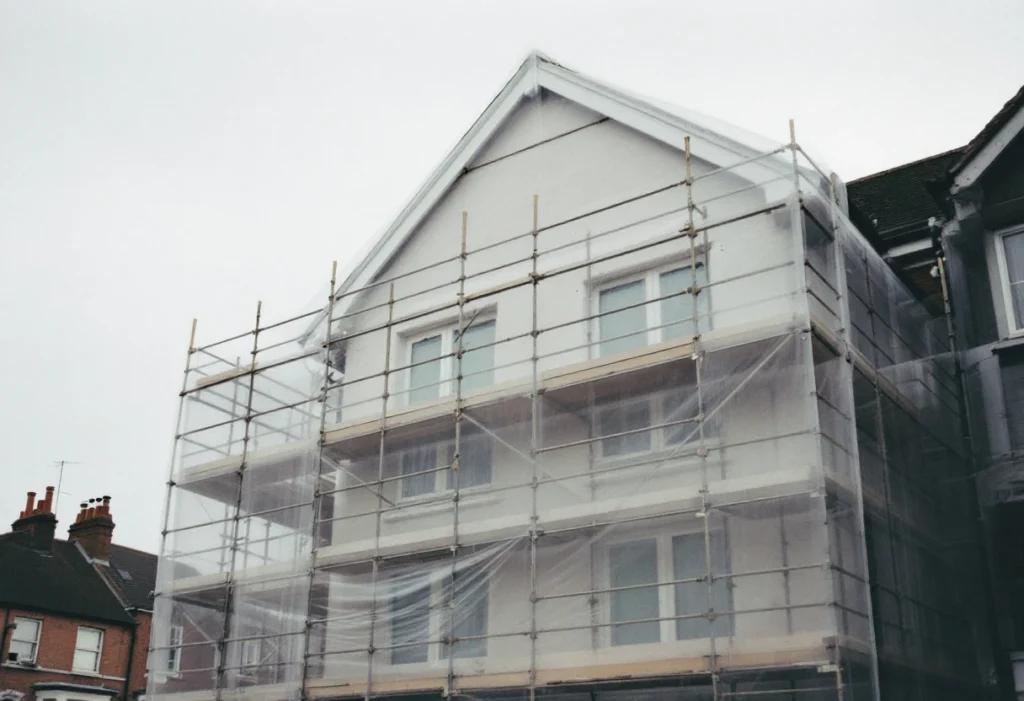
Much of a render job happens before the first coat. The wall has to be reachable, clear of fittings and ready for the chosen system, and the house around it protected. Then the weather has its say, because frost, rain, strong sun and wind can damage render that has not cured.
This guide covers the customer side: what to settle, what to clear and how the weather shapes the programme. What the work involves on site, and how a system is matched to the wall, is on the exterior rendering page.
What to settle before the scaffold goes up
Approvals. In a conservation area, a National Park, an Area of Outstanding Natural Beauty or the Broads, you need planning permission before cladding the outside of a house with render or pebble dash. A listed building needs listed building consent for any significant works[1]. Where more than half of a wall's surface is re-rendered, regulation 23 of the Building Regulations requires the whole wall to be brought up to the energy standard as far as is feasible[13]; the Planning Portal advises that the regulations normally apply from a quarter of an external wall[2].
- The wall and the system. The background is the wall the render goes on: old render, pebbledash, brick or block. The system is chosen to suit it, and its technical instructions then govern the work, weather included. Before work starts you get a written scope with the quotation. It states what is included, what is not, and what is provisional because it cannot be known until the old render comes off.
Asbestos in older buildings. HSE says asbestos can be present in any building built or refurbished before 2000[10]. Its list of locations includes external soffits, and asbestos cement gutters, downpipes and wall cladding[9]. Ask for anything the job will disturb to be checked first.
- Where the scaffold will stand. On the pavement or road it will probably need a licence (step 2). On a neighbour's land, agree it with them before the date is fixed.
How to prepare the house, step by step
1. Clear access around the house
Each wall being rendered needs a clear strip at its base for the scaffold. Move bins, bikes, garden furniture, pots and anything kept in side passages. Agree which gate the trades will use, and whether a shed, fence panel or trellis has to come down.
2. Scaffolding and any licence for the highway
HSE says scaffolds must be designed, erected, altered and dismantled only by competent people[6]. Where the work obstructs a public footpath or road, a licence from the local highway authority will probably be needed before it can begin. The licence can set how the scaffold is built, marked and lit[3]. In Lambeth, for example, the principal or building contractor applies, with 20 working days' notice[4]. Ask who is applying and when.
3. Protect plants, paths and drains
Lift the pots and plants you want to keep, and agree how beds, lawns, paths, drives and drains will be covered. Keep children and pets away from the mixing area. HSE warns that wet cement can cause a serious burn or ulcer if it is trapped against the skin, and chemical burns to the eyes[11].
4. Take down what is fixed to the walls
Most fittings on a wall being rendered come off so the wall behind can be finished, then go back afterwards. Walk round the house and list them:
- Rainwater goods. Gutters and downpipes. Ask where the rainwater goes while they are off.
- Dishes and aerials. These may need realigning when they go back.
- Wired items. Outside lights, cameras and alarm boxes, which an electrician should make safe before they come down.
- Everything else. Hose reels, house numbers, trellis and brackets. For phone cables, ask your provider early.
Agree in writing who takes each item down and puts it back.
5. Keep flues and air vents clear
Gas Safe Register says not to block or cover air vents and flues, because gas appliances need them to work safely. It warns that scaffolding can cover or damage a chimney terminal or flue, and that cladding must not obstruct them[8]. Treat scaffold sheeting, masking film and the render itself the same way. Only a Gas Safe registered engineer should move a flue[8]. Where a job includes gas work, we arrange it through a subcontracted gas engineer.
6. Mask windows and doors
Windows, doors and sills next to the wall are covered with film or sheeting before the render goes on. Ask how long each will stay covered, because a masked window cannot be opened, and agree which door you will use. The masking must leave air vents and flues open[8].
7. Tell the neighbours
Give them the dates the scaffold goes up and comes down, the working hours and where deliveries and any skip will go. If anything needs to go on or over their side, agree it in writing first.
8. Plan parking and deliveries
Scaffold lorries, deliveries and skips need somewhere to stop. On a street with parking controls, a bay may need suspending, and each council sets its own notice. Lambeth asks for at least 10 working days for a standard suspension, including skips on the highway[5]. Book early, because a late booking can delay the start.
How does weather affect the dates and the curing?
No single temperature, drying time or season applies to every render. The selected system's technical instructions set the conditions for putting it on, the time between coats and how long the finished work needs protecting. Lime, sand and cement, monocouche and thin-coat systems differ, so the figures come from the product.
Historic England's guidance on lime mortars, written for repointing, shows the principles. It says to avoid lime work on very cold, very hot or very windy days, and to work in spring, summer or early autumn if possible. Work under way needs protecting from wind, rain and strong sunlight to avoid damage or rapid drying, with particular care over frost. Ventilated covers such as hessian are often used, with mist spraying to keep the mortar damp as it sets[12].
The weather also has to be safe for the people on the scaffold. HSE's guide says to take account of weather conditions that could compromise worker safety[7], and a scaffold must be inspected after anything liable to affect its safety, such as high winds[6].
Weather and fresh render
| Condition | Why it matters | What it can mean for the programme |
|---|---|---|
| Frost and cold | Frost can damage work that has not cured; lime work in winter needs protection against frost[12] | A later start, or covers kept on; the system's instructions set the lowest temperature |
| Rain and driving rain | Fresh work needs protecting from rain; plastic sheeting or tarpaulins may be needed in front of covers in driving rain[12] | Coats paused until the wall and the forecast suit the system |
| Strong sun and heat | Strong sunlight can dry the work too fast; lime guidance avoids very hot days[12] | Covers and damping where the system calls for them, or a later date |
| Strong wind | Wind dries fresh work and can make work at height unsafe; scaffolds are inspected after high winds[6][7] | Work paused; HSE says never to sheet a scaffold without informing those involved in its design and erection[6] |
| After the last coat | Protection stays until the work can resist rain and frost; for lime repointing, at least a week[12] | Protection kept on for the period the system's instructions set |
Scroll sideways to see all columns
So a rendering start date is less certain than one for indoor work. A forecast of frost, heavy rain or high wind in the days after a coat can be reason to wait, even on a dry morning. For lime repointing, Historic England recommends protection for at least a week after finishing, and longer in extreme weather or for autumn work[12]. For other renders, the system's instructions set the period.
When the plan changes
- The forecast turns. Expect the date to move rather than the work to go ahead in conditions the system does not allow.
- The wall is worse than it looked. Old render can hide cracks, loose brick or past repairs. That is why part of the background is provisional, and anything that departs from the scope is agreed with you before it is built.
A flue is in the way. The scaffold and the render work around it. Moving it is work for a Gas Safe registered engineer[8].
- The licence or parking suspension is late. A scaffold on the highway waits for its licence, and the start moves with it.
Suspect asbestos turns up. HSE says to stop work immediately on finding material you think may contain asbestos[10].
What to expect when the render is finished
Once the system's instructions allow, the masking comes off, the fittings go back and the scaffold comes down. Check the work while the scaffold is still up if you can, looking at the edges around openings and fittings and at the base of the wall. Ask before drilling into new render to fit anything new.
At handover you receive the certificates and sign-offs that apply to the work done. Looking after the render over the years is covered in long-term render maintenance.