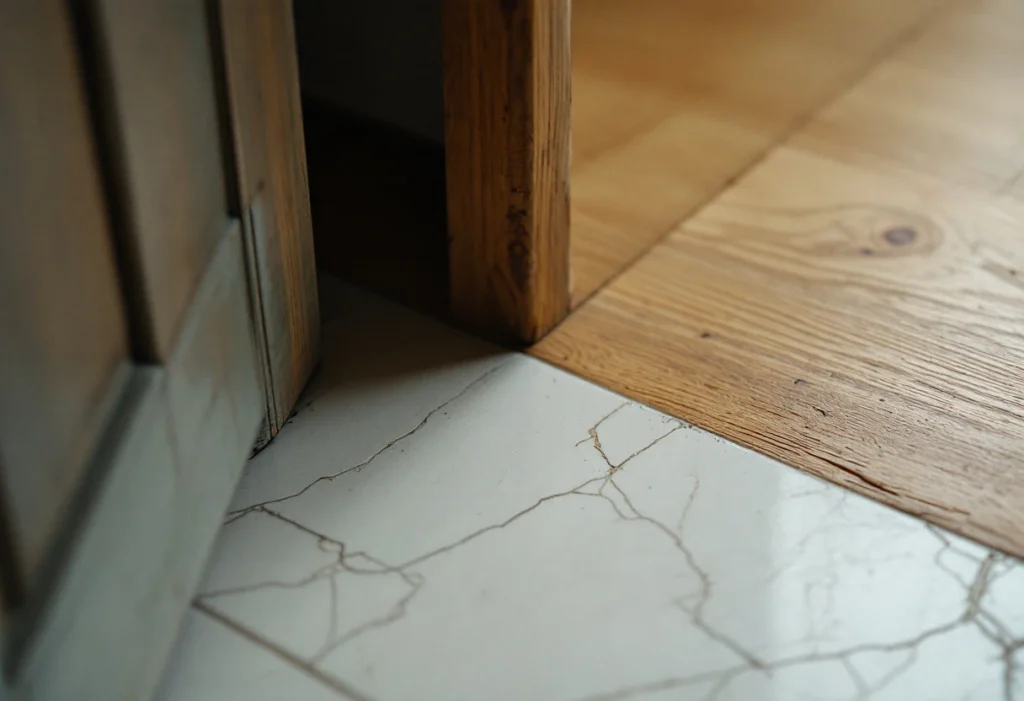
A cracked tile or a lifting board is a symptom, not a cause. The same crack can come from several problems, and the repair depends on which one it is.
This guide covers the possible causes for tiled and wood floors, and the signs that need a proper assessment. It is not a diagnosis: only someone who can see the floor, and often lift part of it, can say which cause applies. Preparing a subfloor before a new floor goes down is a separate subject.
What can the symptoms point to?
Start with what you can see and hear. Most symptoms have more than one possible cause, so treat the table as a starting point.
Symptoms and possible factors
| Symptom | Possible factors | What to note |
|---|---|---|
| Cracks running across several tiles in a line | Movement in the base, a joint or crack in the screed below, or a missing movement joint | Where the line runs, and whether it meets a doorway, a wall or a change of floor |
| A single cracked tile | An impact, or a gap in the adhesive under the tile | Whether something was dropped, and whether the tile sounds hollow |
| Tiles that sound hollow when tapped | Gaps in the adhesive bed, or a bond that has failed | How many tiles, where they are, and whether any rock underfoot |
| Tiles lifting or rising in a ridge | No movement joints at the edges or across a large floor, or heating brought up too fast | Whether the tiles run tight to walls, door frames or pipes |
| Cracked grout across the room | A timber floor flexing underfoot, or movement in the base | Whether the cracks follow the main walking route |
| Wood boards cupped, edges higher than centres | Moisture reaching the boards from below, or water from a leak or spill | Damp patches, water marks, a musty smell, blocked air bricks outside |
| Wood boards lifting or arching up | No expansion gap at the edges, or a leak | Whether the boards run tight to the wall or skirting |
| Gaps opening between boards | Changes in humidity and heating, or a floor drying out after it was wet | When the gaps appeared, and whether they close again |
| Squeaks or creaks | Loose fixings, or boards moving against each other or the joists | Where and when the noise happens |
| A floor that sags, bounces or slopes | A problem with the joists or the structure below | Cracks in nearby walls; get an assessment |
Scroll sideways to see all columns
Why do floor tiles crack or sound hollow?
Tiling is only as steady as its base. The Tile Association's guide asks for a base that is dimensionally stable and able to carry the tiling for its use and traffic[2]. These are the factors to rule in or out.
Movement or flex in a timber floor
Joists should be sized for their span[3], and a timber floor that flexes underfoot can crack tiles or grout. The boards matter too. The Tile Association's 2026 Tiling Guide says to avoid boards that move with changes in moisture content, and that plywood and other wood-based boards should not be used for direct tiling[2]. Its FAQ gives 15mm plywood as the minimum overlay on a timber floor recommended in BS 5385-3, screwed at 300mm centres[1]. So the build-up over a timber floor follows the tile and adhesive makers' system.
An uncoupling membrane under the tiles is designed to take moderate sideways stress, such as drying shrinkage in the base. Movement joints are still needed down to the membrane[2].
Missing movement joints
Tiled floors need movement joints as well as grout. The guide calls for flexible joints at least 6mm wide, through the full depth of the tiling. They go around the edge of the floor, including door thresholds, and across larger floors every 8 to 10 metres. They are also needed where different bases meet[2]. Tiles laid tight to the walls are worth noting.
Gaps in the adhesive bed
On floors, the guide asks for 100% adhesive coverage with no voids, and says tiles should not be fixed with dabs of adhesive[2]. A tile with gaps underneath is not fully supported, and it may sound hollow when tapped.
A screed that was not cured or dry
A new screed can shrink as it dries[2]. The Tile Association says a cement and sand screed must cure for at least 7 days, kept from drying too fast, then dry for a further 2 weeks[1]. For calcium sulfate (anhydrite) screeds, the guide allows 1 day per mm of thickness up to 40mm, then 2 days per mm, in well-ventilated rooms at 20°C or more. The target is no more than 1% moisture by weight or 75% relative humidity[2].
Calcium sulfate screeds form a weak surface layer, called laitance, that must be removed before tiling. Cement-based adhesive can also react with the gypsum to form ettringite, which could make tiles debond[2].
Underfloor heating brought up too fast
The guide says underfloor heating should be fully commissioned in controlled stages, before and after tiling, to minimise drying shrinkage. Heated floors should be split into bays of no more than 40 square metres, with no edge over 8 metres[2]. Note the date if cracks appeared soon after the heating was first used.
Why do wood floors lift, cup, gap or squeak?
Moisture and movement problems can look alike on the surface, so each of these is checked.
Moisture from the subfloor
New ground floors are built to resist ground moisture under the Building Regulations. A new solid floor has a damp-proof membrane. A suspended timber floor needs a ventilated gap of at least 150mm below the timbers, with air vents that let air cross from one side of the building to the other, to stop moisture gathering[3]. In walls, a damp-proof course prevents rising or penetrating damp[6]. A damaged membrane, or air bricks covered by soil or paving, can let moisture reach the boards.
A leak
Water from a pipe, radiator valve, appliance or shower can soak into boards from below or from the edges. Damage near a kitchen, bathroom or radiator is a reason to look for a leak first.
No room to move at the edges
Wood floors are normally laid with an expansion gap at the edges, hidden by skirting or beading, as the maker's instructions set out. Boards fitted tight to walls, frames or pipes have no room to move, which can make a floor lift.
Changes in humidity and heating
Gaps that open in the heating season and close in damper months follow the conditions in the room. Gaps that keep growing, or boards that lift, are a different signal.
Squeaks and creaks
Squeaks come from movement: a loose board, fixings that no longer grip, or boards rubbing on each other or the joists. If the same spot bounces or sags, treat it as a structural question.
What can you check yourself?
Keep to looking and recording. Do not lift tiles or boards, or open up the floor near pipes or cables.
- Look and listen. Note where the cracks run and whether they meet a doorway, wall or change of floor. Listen for hollow or creaking spots.
Measure and photograph. Note the length of each crack and the date, with photos from the same spot every few weeks. Citizens Advice suggests photos and dated notes as evidence if you raise a problem with a trader[5].
- Check for leaks. Look for damp patches, water marks or a musty smell near pipes, radiators, appliances and showers. Outside, check that air bricks are clear.
- Note the history. Record when the floor was laid and whether the damage followed a leak, new heating or building work.
When should you get an assessment?
Get the floor assessed if you see any of these:
- Cracks that lengthen, widen or spread to more tiles.
- Damp, staining or a musty smell, or boards that stay cupped.
- A known or suspected leak under or near the floor.
- A floor that sags, bounces or slopes.
- New or widening cracks in walls near the floor.
Cracks in walls and floors together can point to structural movement. Foundations can move because of poor soil or changes in soil conditions, which is subsidence. Before underpinning, a trial hole is generally dug beside the footings so a structural engineer or surveyor can assess them[4]. That is not a question for a flooring installer.
If the floor was laid recently, the Consumer Rights Act 2015 says the work must be done with reasonable care and skill, and you can ask the trader to fix the problem[5].
How is the fix decided?
The repair follows the cause. New tiles over a floor that still flexes, or new boards over a damp subfloor, can fail the same way. Finding the cause can mean lifting a small area to see the base, the bed or fixings, and any moisture.
Some faults can be put right locally. Others mean taking up the floor and dealing with the base first. If the floor has to come up, our guide to choosing between tile and wood for the room compares the two finishes.
Floor tiling and wood flooring can each be booked with us as a standalone job; see our flooring installation page. The site visit and the written quotation are free, and neither commits you to anything. With the quotation you get a written scope stating what is included, what is not, and what is provisional because it cannot be known until the old floor comes up.